
Bounty hunting on Immortal Realm is a three-branch system that connects PvP combat, civic justice, and the High Ledger's public-records infrastructure. It is one of the shard's strongest examples of how custom systems link together: a single bounty hunt can touch combat mechanics, prison mechanics, contract law, and the live web bounty board all in one flow.
This guide covers how the system works. The companion page How Hunter Writs Work covers how to use the live bounty board on the website.
What Hunter Writs Are
A Hunter Writ is a public bounty notice posted on the Board of Writs. It identifies a target, a branch, a fixed term, and a fixed PvP Token reward. Three branches exist:
Player Writs
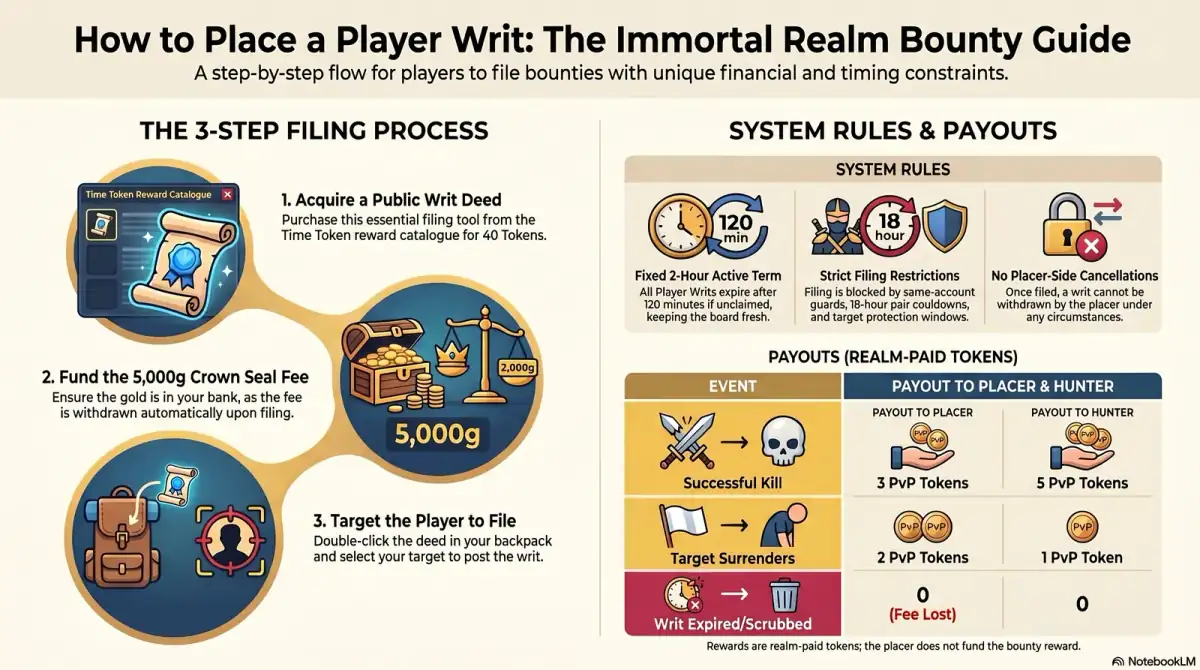
Filed by individual players against other players via the Public Writ Deed (40 Time Tokens at the reward catalog, double-clicked from the placer's backpack and targeted at a player). Typical reasons:
- Another player has killed yours in PvP and you want a hunt commissioned.
- Another player has welshed on a contract or done another civic harm.
- A guild wants to mark a rival's named characters as hunt-worthy.
Player Writs are not funded by the filer beyond the 5,000g Crown seal fee. The reward (5 PvP Tokens to the hunter on a successful kill) is realm-paid. Placers don't set rewards or expiries — both are fixed.
Crown Writs
Realm-issued, with NPC targets. Crown Writs are the system's auto-fill lane for hunters who want official-warrant work without waiting for a Player Writ to surface. They:
- Carry the realm's authority and Crown branding.
- Appear in their own branch on the board with a 150-minute term (
CrownWritTermMinutes). - Have their own ranking ladder (Crown Hunter rankings).
- Are not player-filed — players engage by claiming them, not by issuing them.
- Cap at
MaxAutoCrownWrits = 4auto-spawned Crown Writs on the board at once. The Ledger lane has its own separate cap (MaxLedgerCrownWrits = 4) so player-officialized writs don't crowd the auto-fill pool.
The High Ledger can additionally co-sign a Player Writ with an Arbiter's seal, producing an officialized writ that wears Crown branding while still resolving against a player target. See the High Ledger Guide for that pathway.
Prestige Writs
Patron-issued public commissions, tied to specific civic figures and campaigns. They:
- Carry the longest board term — 360 minutes (6 hours,
PrestigeWritTermMinutes). - Are visibly separated on the board with patron attribution.
- Often draw the attention of higher-ranked hunters.
- Cap at one active commission per patron (
MaxActivePrestigeCommissionsPerPatron = 1) — patrons can't flood the board with their own writs.
Prestige Writs are how the bounty system intersects with player politics — when a patron wants to publicly mark an enemy of the realm, a Prestige Writ is the formal vehicle.
How to Place a Writ
For Player Writs (the player-side path):
- Acquire a Public Writ Deed — 40 Time Tokens at the reward catalog.
- Make sure you have 5,000 gold in your bank (the Crown seal fee is withdrawn from bank).
- Double-click the deed in your backpack and target the player you wish to file against.
- The system runs filing checks (same-account, close-relationship, target protection, pair cooldown, target imprisonment, target already on a writ). On pass, the fee is withdrawn, the deed is consumed, and the writ posts to the board.
- The writ stays on the board for 120 minutes (2 hours). There is no placer-set expiry, no placer-set reward, and no placer-side cancellation.
Note: an 18-hour cooldown applies between repeat writs against the same placer/target pair — you cannot spam-file. Same-account and close-relationship guards reject collusion attempts before the fee is charged.
For Crown Writs: realm-issued; players cannot file these directly. Engage by claiming them off the board.
For Prestige Writs: patron-issued; the patron-commission lane is its own pathway, not the same item-and-target-cursor flow.
The detailed walkthrough lives at How to Place a Bounty.
How to Claim a Writ
To claim a writ, you must:
- Have a Hunter's Warrant in your pack — 15 Time Tokens at the reward catalog, consumed when you accept a writ off the Board.
- Identify the target on the public board (web at
/bounties, or the in-game Board of Writs). - Accept the writ at the in-game board. The system locks the writ to your serial; only you can collect the kill bounty.
- Locate the target within the hunt window. Player Writs: 30 minutes after acceptance. Crown Writs: 35 minutes. Prestige Writs: 45 minutes.
- Defeat the target in combat. The system tracks the kill and resolves the claim.
- Receive the reward — PvP Tokens, realm-paid (no gold escrow exists for Player Writs).
Token Rewards (Verified)
Player Writs pay PvP Tokens only — there is no gold escrow on Player Writs (RewardGold = 0 in the entry construction). Verified payouts from BountyConfig:
| Outcome | Tokens | Constant |
|---|---|---|
| Hunter kills the target | 5 | PlayerKillRewardTokens |
| Placer (writ filer) sees their writ fulfilled | 3 | PlayerPlacerRewardTokens |
| Target surrenders to the Warden | 2 to placer / 1 to hunter | SurrenderRewardTokens / HunterSurrenderRewardTokens |
| Target survives the writ to expiry | 2 to target | ExpiryEscapeRewardTokens |
Crown Writs and Prestige Writs use their own per-template RewardGold + RewardTokens values defined per CrownWritTemplate, not the Player-Writ flat constants.
Verified anti-abuse layers (the actual checks in PlaceBounty):
SameAccount— block writs filed against another character on your own account.AreRelatedForCollusion— close-relationship guard rejects filings between accounts judged too closely related.IsProtectedTarget— 45-minute Crown protection window after a target's previous writ resolves.PairFilingCooldownHours = 18— placer can't refile against same target within 18 hours of resolution.RecentPairSuppressionMinutes = 60— same hunter/target pair suppression after a successful claim, preventing instant rotation between two players.- One writ per target at a time.
There is no specific party-coordinated-kill detection in code; the SameAccount and close-relationship guards plus the 60-minute hunter/target suppression are what discourage the obvious gaming patterns.
Prison and Surrender
A player on the receiving end of a successful claim is imprisoned. Mechanics:
- Imprisonment moves the character to the Warden's prison on Trammel at
(2958, 3448, 0)(verifiedPrisonLocationandPrisonMap = Map.Trammel) for a base duration of 15 minutes (PrisonDurationMinutes). The prison region (PrisonBounds) covers a 20×20 box at (2948, 3438). On release the character is moved to(2968, 3444, 15)(ReleaseLocation). - Target protection — after release, the freed character has 45 minutes of writ immunity (
TargetProtectionMinutes) during which a new writ cannot be filed against them. - Surrender is the target's voluntary path. A player with an active writ on their head can yield to the Warden — accepting a 15-minute prison stint instead of fighting the hunter. Surrender pays 2 PvP Tokens to the placer and 1 PvP Token to the hunter (if there's an active claim), and discharges the writ.
- Bail / Parole are Ledger-crafted instruments (Bail Contract from Recorder+, Parole Deed from Witness+); see High Ledger Guide for the rank-tiered details.
The full justice flow is documented in High Ledger Guide. The bounty system depends on it; the two systems are designed together.
Hunter Rankings
Active hunters are ranked. The bounty board surfaces:
- Hunter rankings — total writs claimed, recent activity, branch breakdown (Player / Crown / Prestige are tracked separately as well as overall).
- Patron rankings — for Prestige Writ funders (highest commissions, most visible patrons).
- Hall records — historical archive of significant bounty events. Capped at
MaxHallRecords = 40entries; older significant events roll off as new ones land.
Rankings are public. Top-ranked hunters become recognizable shard figures with reputations to defend; top patrons become known by name.
Using the Web Bounty Board
The live bounty board lives at /bounties. It shows:
- All active writs by branch (Player / Crown / Prestige).
- Each writ's target, reward, expiry, and status (Active / Claimed / Resolved).
- The prisoner roster — currently imprisoned characters, sentence durations, parole status.
- Hall records — recent significant events.
- Hunter and patron rankings.
- Your personal writs summary if logged in.
A walk-through specifically of how to read and use the board is in How Hunter Writs Work. In-game, type [bounties or [writs (both registered as AccessLevel.Player) to open the Board of Writs without needing to walk to a physical board.
How Bounties Connect to PvP
For PvPers, the bounty system is one of the strongest reasons to engage with Felucca beyond raw gold and Powerscrolls:
- Reputation track. Hunter rank is a separate prestige axis from skill level or gear; even a mid-skill character can climb hunter rankings through volume.
- Funded engagements. Instead of looking for fights, you can claim writs — every fight you take has a bounty attached and a structured outcome.
- Public visibility. Top hunters are known. The shard is small enough that named hunters develop real reputation.
- Civic justice. A PvPer who racks up murders eventually attracts Crown Writs. The system creates feedback — uncontrolled killing produces hunters coming after you, which keeps the PvP ecosystem self-regulating.
For non-PvPers, the system still touches you indirectly — through the patron lane (you can fund a Prestige Writ without being the one who fights), through the contract layer when civic disputes escalate to bounty filings, and through the public board as a record of what's happening on the shard.
Where to Read Next
- For the live board mechanics, How Hunter Writs Work.
- For active writs to view or claim,
/bounties. - For the civic-justice / parole / bail mechanics, High Ledger Guide.
- For PvP context, PvP on Immortal Realm.
- The download page is the on-ramp when you're ready.
Visual reference
Click to enlarge.