
Civic Justice is Immortal Realm's law layer. PvP and criminal acts in guarded regions don't disappear — they get tracked, witnessed, and turned into warrants the High Ledger can act on. The system sits at the intersection of civic Order play, the bounty system, and the realm's overall sense that actions have public consequences.
This page covers what the system covers, how it works, and how to engage with it (or avoid it).
What Civic Justice Covers
The system tracks criminal acts in guarded regions. Specifically:
- Attacking another player inside a guarded zone (Britain, Vesper, Trinsic, etc.).
- Stealing in a guarded zone.
- Other criminal flags as defined by
GuardedRegion.OnCriminalAction.
What it doesn't cover:
- PvP in Felucca and other unguarded zones (handled by the Bounty system instead).
- Combat with monsters.
- Trade, crafting, conversation, normal in-world activity.
- Acts in regions that explicitly aren't guarded (e.g., dungeons, wilderness routes).
The split between Civic Justice (guarded-zone crimes) and Bounty Hunting (Felucca-tracked PvP) is deliberate. Different layers handle different kinds of conflict.
The CrimeTracker Window
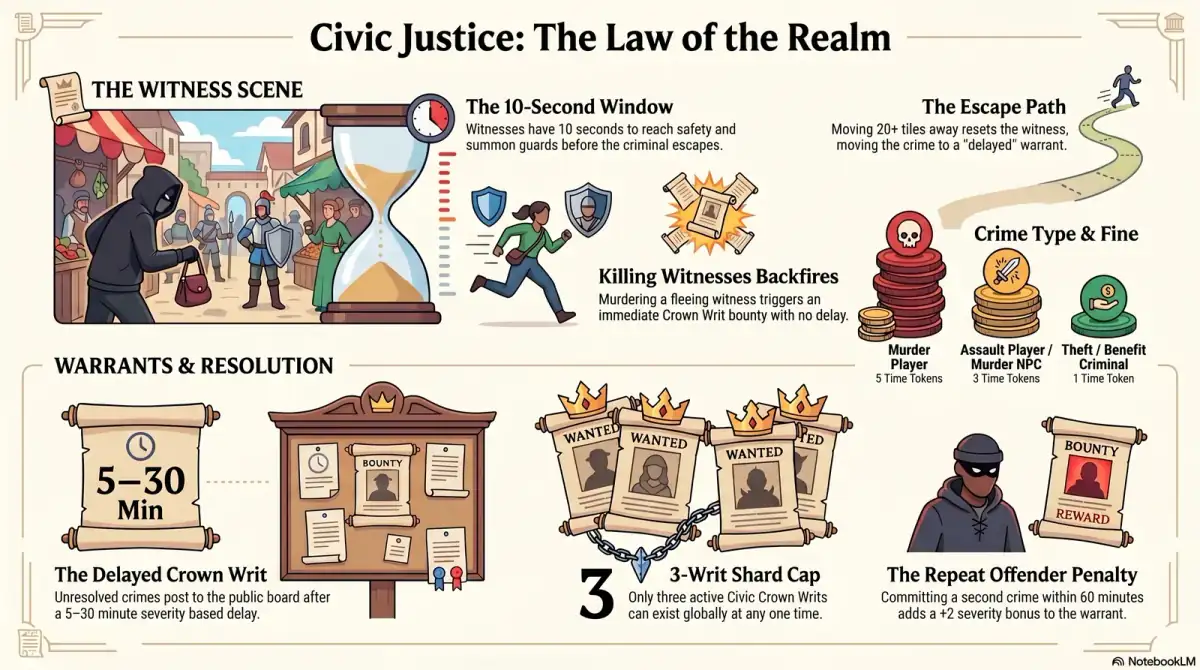
When a criminal act fires (in a guarded region, off Felucca), the system records it with a timestamp and the actor's identity. Mechanics:
- Each record auto-expires 60 minutes after its own timestamp (
ExpiryWindow = TimeSpan.FromMinutes(60)). Records age out individually, not as a batch on inactivity. - If the actor already has 1+ unexpired record at the moment of a new crime, the new crime gets +2 severity (repeat-offender bonus).
- A separate convoy hook can apply an additional +2 severity bump on civic-supplier convoy attacks (
BumpSeverity) — attacking civic shipments is treated as more serious than attacking generic NPCs. - A Chirurgeon Clean Record buff (granted by the Absolve civic power) mitigates severity on the next crime, single-use, and runs before the repeat-offender bump — so a covered offender still gets the full repeat penalty on their next crime if they keep at it.
- Crime records are transient — the writ engine reads them while they're live. Writs that get filed (via
CivicWritEngine) are durable separately.
The realm tracks seven distinct crime types (verified from the CrimeType enum):
| Crime | What Triggers It | Token Fine |
|---|---|---|
| Snooping | Opening another player's backpack | 0 |
| Theft | Stealing from an NPC or player | 1 |
| BenefitCriminal | Healing or buffing a flagged criminal | 1 |
| AssaultNpc | Attacking an innocent NPC | 2 |
| AssaultPlayer | Aggressing another player in a guarded area | 3 |
| MurderNpc | Killing an innocent NPC | 3 |
| MurderPlayer | Killing another player | 5 |
Every recorded crime deducts Time Tokens immediately. The fine is taken from the player's Time Token balance the moment the crime is logged (capped at the current balance — no debt). This is in addition to any severity-driven warrant or bounty consequences. Spree behavior has a real cumulative cost curve: a guarded-zone murder + a follow-up assault costs 8 Time Tokens before any warrant paperwork enters the picture.
Witness AI — The Scene the Crime Creates
Crimes in guarded regions don't quietly accumulate evidence — they trigger a live behavioral scene. The witness layer isn't passive evidentiary tracking; it's a specific NPC running for help.
Who can witness. Twelve specific NPC roles are witness-capable: Banker, Barkeeper, Blacksmith, Armorer, Weaponsmith, Provisioner, Tailor, Jeweler, Tinker, Scribe, TownCrier, Healer (matched via IsAssignableFrom, so subclassed/custom variants count too).
What happens when one sees a crime. A nearby witness-capable NPC starts a WitnessRunTimer:
- The witness shouts a panicked line and starts running away from the criminal toward safety.
- Periodic panicked shouts every ~3 seconds.
- The criminal has roughly 10 seconds (or until the witness has moved 8 tiles) to act.
Three outcomes:
| Outcome | Trigger | Consequence |
|---|---|---|
| Witness reaches safety | 10 seconds OR 8 tiles of fleeing | Guards are spawned and chase the criminal — the writ engine is suppressed for this crime (guards responded; no delayed Crown Writ). |
| Criminal kills the witness | The criminal (or their pet/summon — owner attribution applies) kills the fleeing NPC | Immediate civic Crown Writ filed against the criminal. No delay. |
| Criminal flees | Criminal moves 20+ tiles away, leaves the map, leaves the region, or 30s hard timeout | Witness calms down. No guards, but the delayed-writ path still applies — see the next section. |
This is the heart of the system. The witness isn't a piece of evidence; the witness is a moving NPC whose path determines whether you get caught immediately, get a Crown Writ a few minutes later, or successfully escape into the delayed-writ branch.
Only one witness run is active per criminal at a time, and an NPC who's already running can't be assigned to another criminal — so multiple-witnesses-stronger-evidence is not a thing. The mechanics route through the single fleeing actor.
Delayed Civic Writs
When guards do not respond to a crime — because the witness was killed, because no witness saw it, or because the criminal escaped the witness's run — the CivicWritEngine schedules a delayed Crown Writ against the criminal. This is the system's "the realm doesn't forget" branch.
Delay formula:
| Severity | Delay before writ posts |
|---|---|
| 1 | ~27 minutes |
| 3 | ~21 minutes |
| 5 | 15 minutes |
| 7 | 9 minutes |
| 9+ | 5 minutes (clamped floor) |
In code: 30 − (severity × 3), clamped to [5, 30] minutes. Higher-severity crimes post writs faster; the lowest crimes give you almost half an hour before the writ lands.
If the criminal commits a higher-severity crime while a delayed evaluation is already pending, the engine upgrades the pending record and recomputes the fire time relative to the original crime — you don't get a fresh full-length window for the upgrade.
Shard-wide cap: MaxCivicWrits = 3 active civic Crown Writs at any time (BountyHuntingSystem.CountActiveCivicWrits). When the cap is full, additional civic-justice writ evaluations don't post. This is a deliberate scarcity gate — Crown Writs from civic justice are visible signal, not noise.
Connection to the High Ledger and Bounty System
Civic Crown Writs land on the public Board of Writs at /bounties, interleaved with player-funded Player Writs and patron-funded Prestige Writs. The mechanism:
- Crown Writ on the board — anyone with a Hunter's Warrant can claim and pursue.
- Successful claim — the target is imprisoned at the Warden's prison (Trammel 2958, 3448; see Bounty Hunting).
- Resolution paths — the Ledger's instruments (Bail Contracts, Parole Deeds) cover the civic re-entry side; surrender at the Warden is the player-controlled exit. See High Ledger Guide.
The High Ledger does not hold a separate "warrant record" you can negotiate against — civic justice expresses itself as a Crown Writ on the bounty board. The Ledger's role is the resolution layer (bail, parole, the formal re-entry instruments), not the warrant-keeping layer.
A serious offender accumulates civic Crown Writs from this engine + Player Writs from individual victims + potentially Prestige Writs from politically-aggrieved guilds. The combined incentives produce hunters with reasons to come after them.
Connection to the College of Chirurgeons
The College's Civic Authority gump exposes two civic verbs that bear on Civic Justice. Both unlock at Attendant rank (2+) and pay 4 service points each:
- Absolve the Prisoner. A Chirurgeon visits a prisoner in the Warden's prison, hears their crime, and absolves them. The absolution reduces the prisoner's sentence and grants them a Clean Record buff. The buff is single-use — the next crime they commit has its severity mitigated by the Clean Record before any repeat-offender bonus is applied. After it covers an offense (or after the buff's expiry tag lapses), it's consumed.
- Bless the Writ. A Chirurgeon blesses an active Crown Writ. The hunter who later fulfills the writ receives a healing boon — a regen, a cure, or a stat-restore effect — on completion. This isn't an absolution mechanic for the target of the writ; it's a healing-flavored blessing on the writ that benefits the hunter.
Neither is a pardon path. Absolve reduces a sentence and softens the next-crime penalty; Bless the Writ buffs the eventual hunter. The combination of Chirurgeon civic engagement plus Ledger paperwork (parole deeds, bail contracts) is what makes structured re-entry possible for offenders who want it.
For the College's own structure, see College of Chirurgeons.
How Law-Abiding Players Experience the System
If you don't commit crimes in guarded regions, you simply don't see this layer. The system runs continuously but is silent for ordinary play:
- Combat with monsters doesn't trigger anything.
- Trading, crafting, gathering, and any normal in-world activity is invisible to Civic Justice.
- PvP in Felucca runs through the Bounty system, not Civic Justice.
- Even occasional accidents (mistakenly attacking the wrong target in a guarded zone, then immediately stopping) typically don't produce warrants — single incidents within the transient window often roll off without consequence.
This is by design. Civic Justice is meant to be invisible to most players, visible to repeat offenders.
How Active PvPers Manage Their Civic Record
For players who do engage in PvP-adjacent gray areas, civic management is a real layer:
- Stay out of guarded zones for crime-flagged activity. Felucca is the appropriate venue —
RecordCrimereturns null on Map.Felucca. - Watch the 60-minute CrimeTracker window — a second crime while a record is unexpired adds +2 severity before the witness scene even fires. A break between acts resets that pressure.
- Decide what to do about a witness fast. A fleeing NPC has 10 seconds (or 8 tiles) before guards spawn. You can't out-think that window — leave the area (20+ tiles), or accept the consequence and let the writ engine schedule a delayed Crown Writ.
- Don't kill witnesses. Killing the fleeing NPC produces an immediate Crown Writ — no delay, no scheduling. It's the worst path.
- Resolve standing Crown Writs through the Warden (surrender) or the Ledger's bail/parole instruments before they accumulate.
- Build relationships with civic Orders — relationships with the Ledger and the College pay dividends when you eventually need a path back.
A career PvPer with messy civic record finds many doors closed; a PvPer who manages the civic side actively keeps options open.
Where to Read Next
- For the institutional side, High Ledger Guide.
- For the bounty system that acts on civic warrants, Immortal Realm Bounty Hunting.
- For the broader PvP context, PvP on Immortal Realm.
- For the College's writ-blessing absolution path, College of Chirurgeons.
- The download page is the on-ramp when you're ready to play.
Visual reference
Click to enlarge.