
The Immortal Realm economy is player-driven. Crafted gear competes with loot drops, materials have scarcity, vendors price against each other, and gold has real sinks that keep the value of currency stable over months of play. This page covers how money actually works on the shard: where gold comes from, where it goes, how the markets function, and why crafted goods stay relevant.
Gold Sources
Where the gold flows in from:
Monster loot
Monsters drop gold scaled by tier and zone — vanilla UO rates apply. There is no Felucca gold multiplier on this shard; same monster, same gold, regardless of facet. Felucca's economic value comes from categorical rewards (Powerscrolls, Fel-exclusive crafting materials, PvP Tokens), not flat gold scaling. Specific gold-per-hour rates depend heavily on monster tier, your skill, and how efficient your loop is — expect noticeable scaling as you progress from low-tier to mid-tier to high-tier content.
A new character earns modestly while learning the basic verbs. The early curve is deliberately tight — gold should feel meaningful in the first weeks rather than abundant. Expect to start producing real income once you've cleared 70+ in your primary combat skill and can solo basic dungeon content.
Quest rewards
The hand-authored quest line pays in a mix of gold and Time tokens (the shard's playtime currency). Quest gold is meaningful but not the primary income stream — it's a top-up while you progress through content. Time tokens are a separate currency from gold — different earn mechanics, different spend catalog, never conflated. The full picture is in Immortal Realm Time Tokens.
Crafting and sales
Crafters earn gold by selling to other players. A working crafter at 80–100 in their primary craft skill produces sellable inventory steadily; income scales with the player vendor placement, market demand, and the crafter's engagement with the trade community. High-end runic and recipe-deed work (e.g. Shadowforged set) commands the largest single-item sales.
Immortal Realm Crafting covers the crafter income path in detail.
Bulk Order Deeds
BOD turn-in rewards include gold pools alongside runic tools. A serious crafter running BODs adds a meaningful gold income stream beyond direct sales.
Felucca-side activities
Champion spawns drop large gold piles alongside Powerscrolls. Felucca farming in general carries a gold premium tied to the PvP risk. Players who specialize in Felucca content can earn meaningfully more than their Trammel counterparts — they pay for it with the loot risk.
Gold Sinks
Where the gold flows out — these are what keep the economy from inflating:
Repairs
Gear takes durability damage from combat use. Repair fees scale with item tier; high-end gear is meaningfully expensive to maintain. A serious PvE character spends 2,000–5,000 gp per hour on repair amortization.
Housing upkeep
Player houses carry weekly upkeep fees. The fee scales with house size; large custom-build houses cost notably more. Skipping upkeep eventually condemns the house, so the sink is mandatory for anyone who wants player housing.
Vendor fees
Player vendors charge daily holding fees scaled with the value of items being held. Active vendors pay a few hundred gp per day; high-stock luxury vendors pay more. The fee discourages permanent stockpiling of unsold inventory.
Crafting reagents
Crafting consumes raw materials — most have a real-money cost from the materials supply chain. Tinkers, alchemists, and scribes spend a meaningful portion of their gold on reagents to sustain their craft.
Recall reagents
Magery's Recall spell consumes mana and reagents (Black Pearl, Bloodmoss, Mandrake Root). A character that uses Recall heavily for travel spends a few hundred gp per day on reagents.
NPC services
Skill training (1–30 from NPC trainers), bank fees (some shards), specialized service NPCs (specific quest givers) charge gold for their services.
The cumulative effect: a typical character's "operating cost" is about 30–50% of their gross gold income at the mid-skill tier. The other 50–70% accumulates as savings, gear, housing, and luxury purchases.
Why Crafted Gear Stays Relevant
The single most distinctive economic feature of the shard is that crafted gear competes with loot drops at the high end. This is not an accident. Three design choices make it stable:
- Crafted items use runic tools. Top-tier runic items are competitive with the best loot drops. The runic supply is gated through BODs, which means crafted-item supply is throttled, which means crafted items don't flood the market.
- High-end recipes require Felucca-exclusive materials. Fel Iron, Blood Crystals, Draconic Scales. These materials have real scarcity (real PvP risk to acquire), so high-end crafted items have real cost.
- Loot drops do NOT directly compete on every stat. A 100-skill warrior with a master-crafted runic sword often out-performs the same warrior with a randomly-rolled monster drop. Drops are a parallel path, not a strictly-better path.
Net effect: the economy has a sustainable "make and sell" loop. Crafters have customers; customers have reasons to buy crafted; the gold flows through both directions.
The Player Vendor Layer
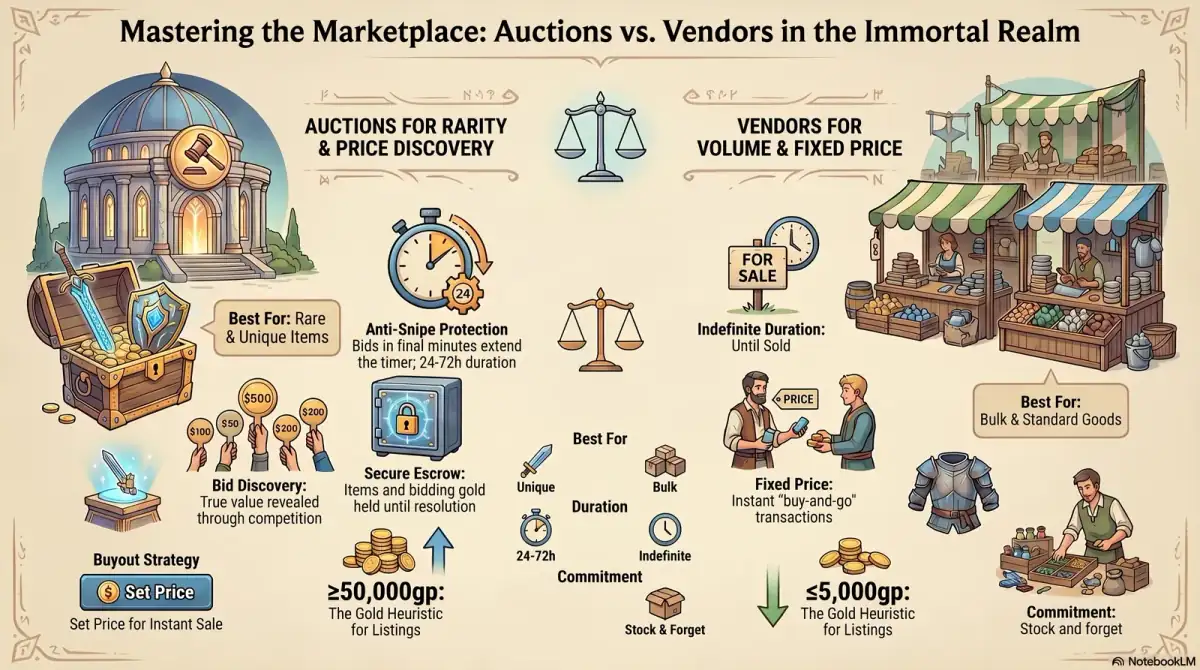
Player housing supports placeable NPC vendors — your house can host a vendor stall. Mechanics:
- A character with a house places a vendor inside.
- The vendor accepts items + prices from the owner.
- Visitors browse the vendor's inventory and purchase via gold.
- Daily vendor fees apply to held inventory.
- The owner collects accumulated gold from the vendor.
This is the standard UO player vendor system. The shard preserves it largely unchanged.
The Web Market Browser
What the shard adds: a web-integrated market browser. Buyers can browse all live vendor inventories from the shard's website without physically visiting houses. Search by item type, price, location, or seller; filter by stat properties on magic items; sort by price or recency.
This makes the player vendor layer scale. Without web browsing, buyers have to physically visit houses to find inventory; the system favors well-located vendors and disadvantages anyone in a remote spot. With web browsing, buyer behavior is more efficient, sellers compete on price rather than location, and the overall economy moves more gold per day.
Browse the live market → · For a step-by-step walkthrough, read the Immortal Realm Market Guide.
The Auction House
The shard runs a web-side auction house alongside the vendor system. Auctions run for 1 to 7 days (sellers pick the duration at listing time; the default is 3 days), have public bidding, and resolve to the highest bidder when the timer ends.
What auctions are good for:
- High-value rare items that wouldn't sell quickly on a vendor.
- Time-sensitive sales when the seller wants gold now.
- Discovery for items where the right buyer might not be browsing the vendor stalls.
Auction house listings are shard-wide visible; competitive bidding produces the strongest price discovery on premium items.
View live auctions → · For seller / buyer mechanics, read the Immortal Realm Auction House Guide.
The `#trade` Discord Channel
The shard's Discord has a dedicated #trade (or equivalent) channel where active crafters, dungeon farmers, and traders announce stock, take commission orders, and negotiate one-off deals. This is where the social economy lives.
A new character can plug into the trade channel without much friction:
- Lurk first to learn what's normal.
- Post WTB (want to buy) messages for items you need.
- Take commission orders from crafters once you've built basic reputation.
- Run weekly market days as a guild or solo operator if that's your speed.
Reputation in the trade channel matters. A crafter known for delivering on time, fairly priced, with consistent quality has long-term customers; a crafter who flakes once burns through their goodwill quickly.
The Felucca-Trammel Economic Loop
The two facets are economically intertwined:
- Felucca produces high-margin materials (Fel Iron, Blood Crystals, Draconic Scales, Powerscrolls).
- Trammel-only crafters need those materials for top-tier recipes.
- Felucca farmers sell materials to Trammel crafters.
- Crafters sell finished gear to fighters of both facets.
- Fighters earn gold from PvE that funds new gear purchases.
The loop is self-sustaining as long as the Felucca population stays active. The shard's PvP design (opt-in but rewarded) is what makes this work — players have real reasons to take the risk, which keeps materials flowing, which keeps the crafter economy alive.
Inflation and Gold Stability
A few intentional design choices keep the gold supply stable over time:
- Strong sinks (housing, repairs, vendor fees) remove gold from the economy continuously.
- Top-tier crafted items have real material costs, so crafter prices stay anchored to material market values.
- No subscription / store gold purchases. The shard doesn't sell gold for real money; the supply curve is purely play-driven.
- Active anti-cheat measures. Scripting and exploits are addressed promptly.
The result: a million gold today is worth roughly a million gold a year from now, in real purchasing power. This is rare in MMOs and is one of the things that makes UO sandbox economies work.
How a New Character Plugs In
A pragmatic on-ramp:
- First two weeks: focus on skill progression. Sell incidental loot to NPC vendors for gold. Avoid expensive purchases.
- Weeks 3–4: pick a side activity (crafting, mining, dungeon farming) that produces real income. Begin selling to other players via trade channel.
- Month 2: place a small house if you want one. Begin engaging with the vendor layer.
- Month 3+: settle into your main economic loop. Crafter, Felucca farmer, dungeon clearer, trader — pick the one that fits and lean in.
A character who engages with the economy earns more, has more social reach, and has more durable accumulated wealth than one who farms gold solo. The economic layer is itself one of the shard's social loops.
The full crafter pitch is in Immortal Realm Crafting. The dungeon side is in Immortal Realm Dungeons. The shard's broader system map is in Immortal Realm Custom Systems. When you're ready to play, the download page is the on-ramp.
Visual reference
Click to enlarge.