

Most "custom shard" pitches are unhelpful because they list features without explaining how they change the game. This page takes the opposite approach: it walks through what the systems actually do, what they're trying to fix in stock UO, and how they fit together.
If you're shard-shopping, this is the page that tells you whether Immortal Realm's design will resonate. If you've already decided to play, Immortal Realm New Player Guide is where the practical starting steps live.
The Design Goal
Immortal Realm exists to do one thing stock UO doesn't quite do: make institutions feel real.
Stock UO has guilds, but they're mostly just tags on a name. It has factions, but they're a treadmill. It has NPCs but no civic life. The world is mechanically rich but socially flat — your interactions with other players are mediated through combat, trade, and chat rather than through institutions with verbs.
Immortal Realm tries to give the world public, embodied institutions: groups players join that have visible duties, public scenes, real social recognition, and meaningful gameplay consequences. That single design instinct shapes most of the custom systems below.
Civic Orders
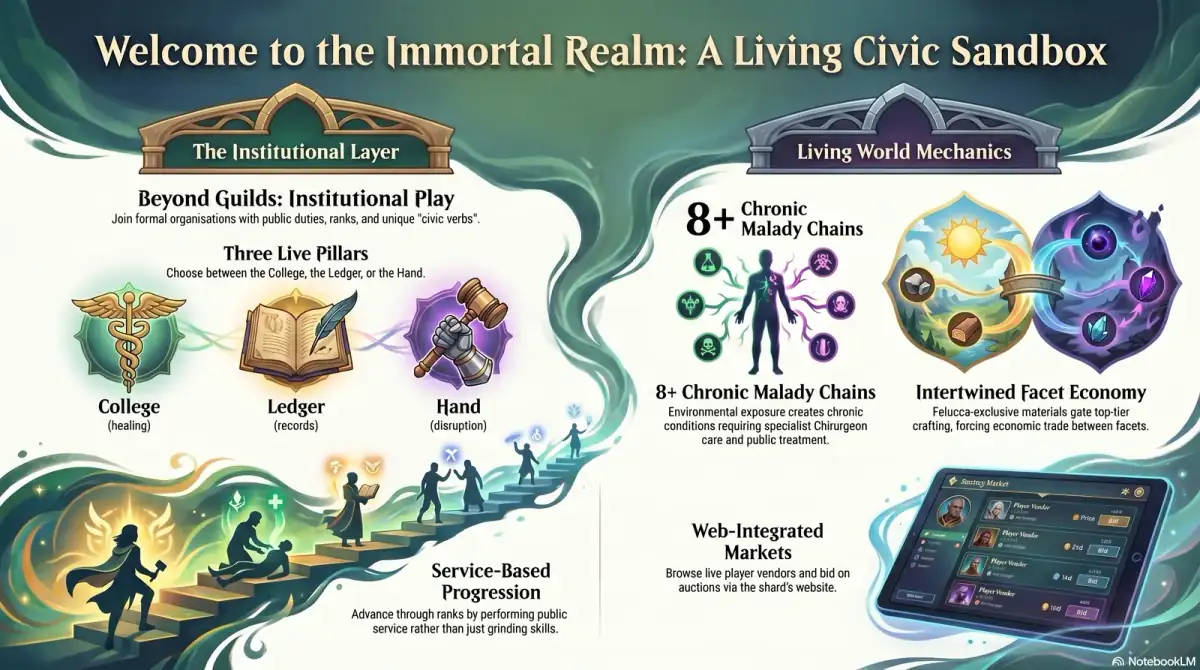
Orders are the heart of the institutional layer. Three live Orders shape the institutional layer today: the College of Chirurgeons, the High Ledger, and the Velvet Hand. Each has its own public verbs, its own rank ladder, and its own relationship to the shard's civic systems. More Orders are on the roadmap.
The College of Chirurgeons treats sick characters. Characters who spend time in dungeons, swamps, prisons, or extended combat acquire maladies — chronic conditions that degrade them slowly. Chirurgeons examine, diagnose, and treat. The interaction has public verbs (a Chirurgeon hailing patients on the street, a public Examination at the Hall, a documented cure attestation) that produce visible scenes. Both sides have real gameplay reasons to participate: patients want cures, Chirurgeons get civic recognition and rank progression.
The High Ledger is the shard's records and civic-instruments institution. Public Records Wall (everyone reads), Filing Desk for two-party contracts (Recorder+ witness or fallback NPC at 500g/1500g), immutable Civic attestations, Bail Contracts and Parole Deeds (rank-tiered crafted items), and Crown Writs (Recorder+ at the Civic Authority gump). The Ledger is the institutional spine the bounty system, civic justice, and Mortal Shock all plug into.
The Velvet Hand is the shard's structural antagonist Order — public face of charity (alms scenes, begging bowls), mechanical work of disrupting bounty writs, freeing prisoners, and crafting structured raid declarations. The Hand exists deliberately as counter-pressure to the realm's enforcement systems.
For the full institutional map, read the Immortal Realm Civic Orders hub. The shape repeats across all three: an Order is a group with a public verb that produces a real scene, not a guild tag.
Maladies and Treatment
Maladies are live and form the core demand loop for the College of Chirurgeons. Environmental exposure, sustained combat, dungeon time, prison stays, and death-related systems create chronic conditions players can manage, self-treat, or bring to civic specialists. Read the Maladies guide and the related Mortal Shock guide for the full picture. The shape:
- Eight registered chains plus the standalone Call Stones malady. Specific activities produce specific chains: Miner Strain (The Shakes is stage 1, mining-driven), Swamp Sickness (Mire Lung is stage 1, swamp travel), Dungeon Sickness (Dungeon Cough → Cave Sickness → Deep Rot from sustained dungeon time), Battle Fatigue and Combat Aches (extended combat), Prison chain (incarceration), Crafting Strain (high-volume crafting), Crowd Sickness (high-traffic city centres). Each chain has its own escalation timer (1h-10h between stages, online time only).
- Some maladies are mild and self-resolving; others chain into worse stages without treatment.
- Treatments use specific tools: Calmleaf Draught for The Shakes, Numbing Draught + Surgeon's Kit for the surgical Call Stones extraction, Steaming Brazier rite for chronic-respiratory work like Mire Lung.
- Treatment is mostly the Chirurgeons' civic role; self-treatment is possible but less effective and produces less reputation.
Net effect: there's a soft demand for civic services that creates real reasons for some characters to specialize in them and for the rest of the population to interact with that specialization publicly.
Custom Progression
The 700-point skill cap is preserved — Immortal Realm is not a "200% of standard UO power" shard. What's different:
- Faster early gains, standard late gains. Skills 1–70 are tuned faster than standard UO so new characters reach competence in a session; 70–100 is the standard productive zone. Reaching 100 in a skill is meant to feel meaningful.
- Powerscrolls remain Felucca-exclusive. The only path past 100 in a skill is the standard champion-spawn loot. This is intentional — keeping the high end of progression coupled to the risk facet keeps Felucca relevant.
- A separate civic / Order rank system that runs parallel to skill progression. You can be an excellent fighter without ever joining an Order; you can be a senior Chirurgeon with mid-tier combat skills. The two ladders are intentionally orthogonal.
Quests Reward Playtime, Not PvP
A small but load-bearing design choice: quests pay out in Time tokens (playtime currency) rather than PvP-faction currency. Time tokens redeem for cosmetics, housing decoration, custom dyes, and a small set of utility items.
The intent is that questing is its own loop, not a feeder for the PvP loop. Players who like quest content get rewards for that content. Players who like PvP get rewards for PvP. Neither is the canonical path; both are real.
Opt-In PvP
Trammel is fully safe — no player-versus-player combat. Felucca is open PvP with significant rewards:
- PvP Token drops from Felucca activity (stackable items, tradeable between players).
- Fel-exclusive crafting materials (Fel Iron Ingots, Blood Crystals, Draconic Scales) that high-end recipes require.
- Powerscrolls from champion spawns — the only path past 100 in a skill.
- Specific quest content and unique drops.
Net effect: Felucca matters. Players who never visit Felucca cap out at standard gear and 100-skill characters; players who venture into Felucca have access to the high end. Crafters who want the rare materials can pay Felucca farmers, which keeps the two populations economically intertwined rather than walled off.
Crafting and Economy
Crafting is a real path on Immortal Realm. The relevant choices:
- Crafted gear competes with loot drops at the high end. Master crafters with runic tools and BODs (Bulk Order Deeds) produce items that rival or exceed monster drops. Crafting is not a stepping stone to a "real" gear loop.
- Fel-exclusive materials gate high-end recipes. Crafters either farm Felucca themselves or buy from those who do. Either way, the risk facet feeds the crafting economy.
- Web-integrated player markets. The shard has public vendor listings and an auction system available through the website, so crafters can market their work without being chained to in-game vendor stalls.
- Real gold sinks. Repairs, housing upkeep, vendor fees, crafting materials. Without sinks, gold inflates and crafted goods become irrelevant; with them, the player economy stays healthy.
A dedicated crafting walkthrough is at Immortal Realm Crafting. For now, the crafting layer is the most mature shard-specific system after the institutional Orders.
Civic Systems You Can Read Next
The shard's deep-system pages, grouped by what they cover.
Orders and Justice
- Civic Orders Hub — meta-guide to the three live institutional Orders.
- College of Chirurgeons — the healing Order with public examinations, ranked progression, and civic verbs.
- High Ledger Guide — public records, contracts, Crown Writs, parole, and civic justice paperwork.
- Velvet Hand — the operations Order: prison disruption, writ disruption, raid deeds, Alms cover.
- Maladies — the chronic-condition system the College treats: exposure sources, chains, and treatment.
- Civic Justice — the law layer: crime tracking, witness AI, warrants, and the connection back to the High Ledger.
- Mortal Shock — death-penalty system with stacking debuffs, gravestones, Last Rites, Death Certificates, and Mourner's Flowers tributes.
- Bounty Hunting — Hunter Writs, the prison system, and the live
/bountiesboard.
Progression and Rewards
- Time Tokens — the playtime currency that runs alongside (and separate from) gold.
- Daily Ledger — daily task rotation with frozen daily picks across five categories, Time Token rewards, and an all-complete bonus.
- Achievements — the seven-category milestone system with token rewards and title deeds.
- TimeWoven — the item-augmentation layer: sockets, essence, and taints.
- Register of Honors — the public title system: earned honorifics across seven categories, single active title, public ledger view.
Guilds, PvP, and Crafting
- Custom Guilds — modernized guild layer: voting, hall seating, treasury, perks, and the forum integration.
- Relics — guild-tied artifacts with the Wild → Recovered → Carried → Seated → Fading → Released cycle and structured raid declarations.
- Fel Iron and Shadowforged — Felucca-exclusive material, recipe deeds from ore elementals, and the GM-Smithy master crafting path.
- Convoys — scheduled NPC caravans with time-in-zone payouts, ambushes, and recoverable cargo.
- Expeditions — instanced 2-4 player charter-based group content with shared progress and a 90-minute timer.
Quests and Collections
- The Rivalry Quest — single-session branching quest with three permanent endings and real world-state changes.
- Living Herbarium — twelve-cultivar botanical collection arc across six families, Herbarium Scrip currency.
- Golden Beads — anchored civic-deed archive with Light/Shadow paths, ambient anchors, hidden clues.
- The Blood Market — three-chapter civic-corruption arc tracking bounty-system manipulation from docks to broker to boss.
- Bounty Orbit Quests — two short narrative quests (The Chaplain's Informant, The Warden's Old Case) introducing the bounty-system NPCs.
- King Whiskers — 60-cat collection with bells currency, royal-flavored vendor, and the Cat Whisperer title.
- Beast Collection — region-and-time-gated beast catalog with Marks of Trust currency, Beastbond layer, and the Beastbinder title.
- Fish Collection — fish catalog with regional and time-gated entries, Silas Rivers (the Old Angler) curator, River Marks currency, and the Riverkeeper title path.
- Lost Recoveries — treasure-and-SOS-recovered archive with themed sets, Archive Marks (primary), and Legendary Fragments + Commendations as tier-2 currencies. Curated by Archivist Thalen.
- Frog Collection — long, light, low-stakes 60-frog collection arc with Frog Coin currency.
- New Haven Welcome Quest — the first-30-minutes on-ramp: welcome quest, seven starter quests, and Young protection.
Social Surface
- The Commons — live four-tab social surface (Needs, Providers, Guilds, People) bridging player demand and supply across civic systems.
- Chat and Channels — whisper system with
[rreply, friends list, persistent mute, custom channels, zone-aware auto-join.
Housing, Decoration, Player Vendors
Standard UO housing is preserved. Place a deed, customize, decorate. The shard is mid-population enough that house plots are available without lottery dynamics.
Active Development
Immortal Realm is an actively developed shard. Public changelog, regular deploys (typically twice a week), a small team that ships. The trade-off is that some systems are mature, some are mid-rollout, and some are in design — you get to be early on a shard whose final shape isn't locked yet.
The Orders layer (Chirurgeons, High Ledger, Velvet Hand) is live and load-bearing. The maladies-and-treatment loop, civic justice, bounty hunting, the Daily Ledger, and Mortal Shock are all live. Active development now focuses on additional Order content, deeper questline arcs, and continued polish on the live tools (/market, /auctions, /bounties) that bridge in-game state to the website.
Where Immortal Realm Doesn't Diverge
Worth being clear about what's not custom:
- Movement, combat formulas, spell mechanics are stock UO. We don't customize the basic game feel.
- The skill list is stock. No "new" skills.
- Magery, Necromancy, Chivalry, Spellweaving, Mysticism are all stock. Spell tomes work as expected.
- Housing rules, NPC vendor systems, the bank box are stock with minor quality-of-life tweaks.
The custom layer sits on top of a stock UO experience. If stock UO is fundamentally not for you, Immortal Realm won't be either.
If this is the kind of design that resonates, Immortal Realm New Player Guide is the next read. If you're shard-shopping more broadly, Best Ultima Online Shards helps you compare by category. When you're ready to play, the download page is the on-ramp.
Visual reference
Click to enlarge.