
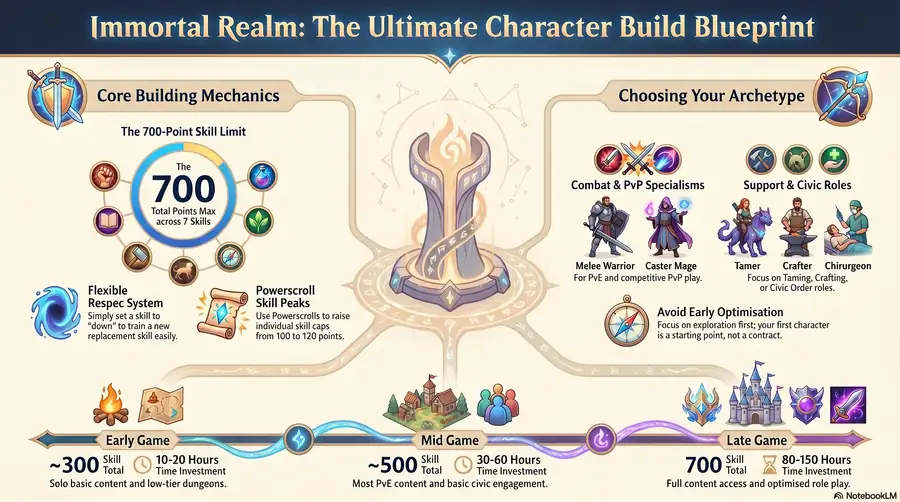
UO has no classes — your character is defined entirely by the seven or so skills you choose to train inside the 700-point cap. That openness is great for veterans and overwhelming for new players. This guide lays out the proven templates that actually work, what they're good at, and the trade-offs each one makes.
These are starting points. Real builds adjust to the shard you're playing, your gear, your Powerscroll situation, and your playstyle. But the templates below are the canon — almost any working UO character in 2026 is a variation of one of them.
How to Read the Templates
Every template lists:
- Skills — seven 100s totaling 700 points, the cap most templates target.
- Suggested stats — Strength / Dexterity / Intelligence within the 225-point pool.
- Strengths — what the build is good at.
- Weaknesses — what kills it.
- Power scrolls — which skills benefit most from the 100→120 cap raise.
You won't have all 700 points or any Powerscrolls when you start — these templates are the destination, not the starting state.
Pure Warrior (Dexer)
The classic UO fighter. Reliable, simple, durable.
Skills: Swordsmanship · Tactics · Anatomy · Healing · Parrying · Magery · Resisting Spells
Stats: 100 STR / 100 DEX / 25 INT
Strengths: high sustained damage, tanky, easy to play, self-healing via bandages.
Weaknesses: predictable, struggles against good ranged attackers, low burst damage.
Power scrolls: Swordsmanship and Tactics first; then Anatomy. Magery only matters as a Recall utility, so 100 is fine.
The Magery slot is for Recall — without it you're a slow target. Some dexers swap Magery for Chivalry (for Close Wounds + Consecrate Weapon); both work, Chivalry is slightly more PvP-flavoured.
Pure Mage
The other classic UO archetype. High burst, mobile, fragile.
Skills: Magery · Eval Int · Meditation · Resisting Spells · Wrestling · Anatomy · Inscription
Stats: 25 STR / 25 DEX / 100 INT (push INT to 125 with stat scrolls eventually)
Strengths: ranged damage, mobility (Recall + Teleport), area control, scales well with high INT.
Weaknesses: fragile in melee, expensive (reagent costs), hard early curve.
Power scrolls: Magery and Eval Int are top priority; Meditation third (mana regen scales with cap).
Wrestling at 100 prevents you being disarmed and gives you a melee floor. Inscription scribes your own spell scrolls, which doubles as a money saver and unlocks high-circle scrolls for emergencies.
Tamer
Pet-driven content. One of UO's strongest PvE solo templates.
Skills: Animal Taming · Animal Lore · Veterinary · Magery · Eval Int · Meditation · Resisting Spells
Stats: 25 STR / 25 DEX / 100 INT
Strengths: pet does most of the damage while you support; can solo content other templates can't; long-term cumulative value (good pets are rare and tradeable).
Weaknesses: slow to skill up early, controversial in PvP (some shards restrict), pet can be killed.
Power scrolls: Animal Taming and Animal Lore — both directly affect which pets you can tame and how good they are.
The early grind to 80+ Animal Taming is the steepest in UO. The reward at the high end is worth it but the climb is real.
Warrior-Mage Hybrid
Flexible, scales well, slightly outclassed by specialists at the top.
Skills: A weapon skill (Sword/Mace/Fence) · Tactics · Anatomy · Healing · Magery · Eval Int · Resisting Spells
Stats: 90 STR / 60 DEX / 75 INT
Strengths: switches between melee and ranged, has self-heal both ways (bandages + Greater Heal), reads the most situations.
Weaknesses: no Meditation = mana regen via potions + nat regen, slightly worse than pure builds in their specialty.
Power scrolls: weapon skill, Tactics, Magery — in that order.
A good "second character" template once you've played a pure build and want more flexibility. Common in casual PvP.
Necromage
A modern variation that uses Necromancy + Spell Weaving alongside Magery for a hybrid caster.
Skills: Magery · Eval Int · Meditation · Necromancy · Spirit Speak · Resisting Spells · Spellweaving
Stats: 25 STR / 25 DEX / 100 INT
Strengths: enormous spell variety, AoE damage via Spellweaving, debuff utility via Necromancy.
Weaknesses: fragile, requires Necromancy reagents (different from Magery), only viable on shards with both schools enabled.
Power scrolls: Magery, Eval Int, Necromancy.
Check that your shard runs Necromancy + Spellweaving with sane balance before committing — some shards disable or rebalance them.
Pure Crafter (Smith)
Economy character. Pair with a fighter alt.
Skills: Blacksmithy · Mining · Arms Lore · Tinkering · Carpentry · Magery · Anatomy
Stats: 100 STR / 25 DEX / 100 INT (high STR for carry capacity)
Strengths: full crafting suite, high gold income from BODs and player sales, mostly safe playstyle.
Weaknesses: poor combat — needs an alt for materials gathering in dangerous zones; vulnerable in PvP.
Power scrolls: Blacksmithy first (top-end recipes), then Mining (ore yield).
Magery is for Recall and self-protection. Anatomy gives a small combat floor for the rare moments you need to fight.
Tailor / Bowyer Crafter
Alternative crafter — leather instead of metal.
Skills: Tailoring · Lumberjacking · Bowcraft / Fletching · Arms Lore · Carpentry · Magery · Anatomy
Stats: 100 STR / 25 DEX / 100 INT
Same shape as the Smith but a different material chain. Tailored leather and crafted bows are their own market; many shards have a strong tailor economy.
Bard
The "other" support archetype. Crowd control rather than damage.
Skills: Provocation · Discordance · Peacemaking · Musicianship · Magery · Eval Int · Resisting Spells
Stats: 25 STR / 25 DEX / 100 INT
Strengths: turn monsters against each other (Provocation), debuff anything (Discordance), powerful in groups.
Weaknesses: low direct damage, build is fully song-dependent, harder PvP profile.
Power scrolls: Provocation, Discordance, Musicianship.
Bards are an underrated PvE solo template — Provocation lets you farm content well above your direct combat capability.
Stealth / Thief
Niche template. Some shards disable thieving entirely; check before committing.
Skills: Stealth · Hiding · Stealing · Snooping · Tactics · Wrestling · Resisting Spells (or Magery for Recall)
Stats: 50 STR / 100 DEX / 75 INT
Strengths: scout, gank, skirmish; high information advantage; rewarding playstyle on shards that support it.
Weaknesses: fragile, often legally murky, restricted on many shards.
This is a deep specialist build. Don't pick it as a first character; pick it once you know the world.
Stat Notes
Across all templates:
- Strength governs hitpoints and carry capacity. Fighters max it; mages keep it low.
- Dexterity governs stamina (which gates swing speed). Dexers max it; mages keep it low.
- Intelligence governs mana (which gates spell-casting). Mages max it; dexers keep it low.
The 225-point cap is split between these three. Stat scrolls (Felucca-exclusive) raise individual caps above 100, up to 125. Most endgame characters target one or two scrolled-up stats and one base stat.
Powerscroll Priorities
Generic priority order across most builds:
- Primary damage skill (combat skill or Magery) — the biggest delta.
- Tactics or Eval Int (whichever multiplies #1).
- Anatomy or Resisting Spells (defensive cap raise).
- The rest — diminishing returns.
A 110/110/110/110/100/100/100 character is meaningfully stronger than a 100×7 character. A 120/120/110/110/100/100/100 character is the practical PvE / PvP top end.
Shard Caveats
Templates are tuned to standard UO mechanics. Specific shards diverge:
- Pre-AOS shards (T2A-era) lack some of the post-AOS skills (Necromancy, Chivalry, Mysticism) and use older spell mechanics. Templates listed above need adjustment.
- Custom-skill shards add or replace skills. Templates have to incorporate the custom skill or skip it.
- Custom-balance shards may rebalance specific abilities — Provocation, Tamer pet damage, Spellweaver area damage are common targets.
Always check your shard's wiki or pinned documentation before committing to a high-investment template. A six-week build that doesn't work on your shard is a six-week mistake.
Where Immortal Realm Fits
Immortal Realm runs standard post-AOS UO mechanics with the Necromancy + Chivalry + Spellweaving + Mysticism schools all available. The templates above all work; specific tunings, the 1–70 gain curve, and the 70–100 grind are covered in Immortal Realm Progression. PvP-viable build choices specifically are in PvP on Immortal Realm. If crafting templates resonate, Immortal Realm Custom Systems covers the shard's economic levers.
For the broader UO context, the pillar Ultima Online Guide and How to Play Ultima Online are the right next reads.
Slide deck
For a slide-format walkthrough of UO build templates:
Ultima Online Blueprints — full slide deck (PDF) · PowerPoint version