
Ultima Online is the original sandbox MMO. Released by Origin Systems in 1997, it predates EverQuest, Dark Age of Camelot, World of Warcraft, and Final Fantasy XIV — every major MMO of the last twenty-five years owes Ultima Online something. It is still played today, primarily on player-run shards that preserve, expand, or reinvent the classic Britannia.
This guide is the entry point. It covers what UO actually is, whether it's worth playing in 2026, how to start, how to choose a shard, and how Immortal Realm fits the landscape.
What is Ultima Online?
Ultima Online is a 2D top-down MMORPG set in the world of Britannia, the setting of the single-player Ultima series. It launched in 1997 and pioneered most of the conventions that modern MMOs took for granted: persistent worlds, player housing, open economies, full-loot PvP, sprawling skill systems, in-game crafting, and emergent player politics.
Compared to modern MMOs, UO is structurally different in three ways:
- No classes. Your character is defined entirely by which skills you train. A 700-point skill cap is split however you want — across combat, magic, crafting, stealth, taming, fishing, you name it.
- No instances. Britannia is a shared open world. Other players can see you, fight you, trade with you, and build houses next to yours.
- No quest-driven leveling. Skills rise by use. You raise Mining by mining, Magery by casting, Tactics by hitting things. There is no XP bar.
That structural freedom is the appeal. It is also why UO can feel disorienting at first — modern MMOs hold your hand; UO mostly does not.
Is Ultima Online Still Active in 2026?
Short answer: yes, on a handful of healthy shards.
The official Ultima Online servers (run today by Broadsword) are still online with a small, devoted population. Most active UO play in 2026 happens on private shards — community-run servers that emulate UO and ship their own custom content. Some recreate classic eras faithfully; others diverge significantly with new systems, items, lore, and balance. Population varies — the largest shards have hundreds of concurrent players in prime time, smaller ones have dozens.
The honest answer to "is UO still worth playing" is: yes, if the sandbox loop appeals to you and you find a shard whose ruleset matches what you want from it. A polished modern MMO it is not. A living, persistent world where players matter, it absolutely still is. The full picture of where the population lives and why UO has outlasted its commercial publisher is in Ultima Online in 2026, and an honest comparison against the modern themepark MMO model (WoW, FFXIV, GW2) is in Ultima Online vs Modern MMOs.
How to Play Ultima Online
The minimum to start playing is:
- Get the Classic Client data files. These are available as a free download from the official Ultima Online website. You install the client to acquire its
Datafolder; you do not need to launch the official client after that. - Install ClassicUO. ClassicUO is the open-source modern client used to connect to nearly every active shard. The launcher handles updates and profile management.
- Pick a shard and create a profile in the launcher. The shard supplies the IP/port. You point ClassicUO at your Classic Client data folder, fill in the connection details, and connect.
- Create your character in-game. Choose a starting profession (Warrior, Mage, Crafter, etc.) and a city. The profession sets your starting skills — you can train any skill later regardless of starting choice.
Step-by-step walk-throughs for setup and first hours of play live in How to Play Ultima Online; a complete client setup walkthrough (Classic Client data files, ClassicUO Launcher, profile configuration, troubleshooting) is in Ultima Online Client Setup Guide for Private Shards.
Best Shards
The best shard for you depends on what you want from UO. Most "best of" lists are unhelpful because they collapse the question to a single rank — but a Felucca PvPer, a roleplayer, and a crafter will all answer it differently.
A more useful framing is by intent:
- Best for new players — shards with a guided New Haven start, generous early gold rates, and forgiving training curves.
- Best for PvP — shards with active Felucca populations, balanced PvP rules, and a healthy guild scene.
- Best for custom systems — shards that diverge significantly from stock UO with new mechanics, classes, items, or lore.
- Best for roleplay / story — shards that ship narrative content, GM-run events, and a coherent world voice.
- Best for crafting and economy — shards where crafting actually matters (crafted gear competes with loot drops) and the player economy is real.
- Best for classic OSI-like play — shards that intentionally mirror specific historical UO eras with minimal divergence.
A more detailed comparison lives in Best Ultima Online Shards.
Official vs Private Servers
The official Broadsword-run servers run the canonical EA ruleset. Private shards run ServUO or RunUO — open-source server emulators that reimplement the UO server protocol. Private shards diverge from official:
- Cost. Most are free; the official servers charge a subscription.
- Population concentration. A few well-run private shards collectively host more concurrent players than any single official server in 2026.
- Custom content. Private shards are the only place to get meaningfully new UO content. The official servers have not shipped a significant expansion in years.
- Stability. Variable. The well-run shards have multi-year uptime histories; smaller ones come and go.
There is no wrong answer. Most active UO players in 2026 play on private shards because that's where the active populations and ongoing development are.
New-Player Tips
A short list, applicable to almost any shard:
- Pick a profession that matches how you want to start, not how you want to end up. All paths converge — your starting skill loadout is just a head start, not a permanent identity.
- Stay in Trammel-equivalent zones until you can hold your own. "Felucca" or its equivalent on most shards is open PvP. New players are loot piñatas there.
- Talk to people. UO is a social game. Most shards have a Discord with knowledgeable players who will answer questions if you ask politely.
- Don't grind alone if you don't have to. Two characters at 50 skill clear content faster than one at 80, and you'll learn the rhythm of group play earlier.
- Read the shard's rules. Different shards have wildly different stances on multi-clienting, scripting, gold-buying, and PvP — assume nothing.
A new-player walkthrough specifically for Immortal Realm lives in Immortal Realm New Player Guide.
Why Play on Immortal Realm?
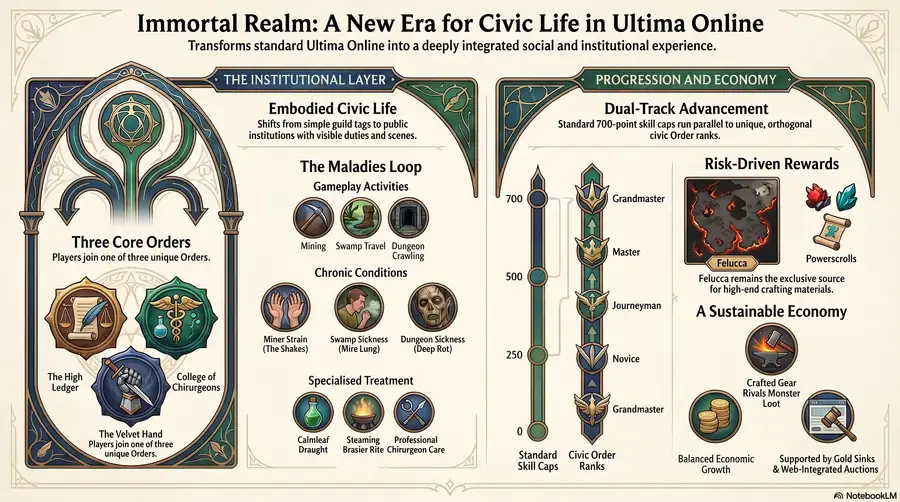
Immortal Realm is a story-driven Ultima Online shard with an opt-in PvP design and an explicit institutional layer — Orders, Guilds with real verbs, public civic systems, a hand-authored quest line, and a custom progression path that respects the 700-point skill cap while expanding the things worth doing inside it.
It is not the right shard for every player. If you want pure 1997-faithful EA-era UO, there are shards built specifically for that. If you want the sandbox plus narrative content, custom systems, and a guided new-player path, Immortal Realm is built around exactly that mix.
Custom Systems
Immortal Realm ships with custom progression systems, civic Orders, a maladies-and-treatment loop, and shard-specific economy levers — not one bolt-on, but a coherent set of overlapping systems that produce social play.
Read Immortal Realm Custom Systems.
New Player Path
New characters start in a guided New Haven. The first hour teaches the basics — movement, combat, skill gain, the bank, the Inn, the trainers — without lecturing. A walk-through with screenshots and recommended early skill choices lives in Immortal Realm New Player Guide.
PvP and Risk
Trammel is a fully safe facet — you can complete the shard's main content without ever engaging in PvP. Felucca is the open-PvP lane with real categorical rewards: Powerscrolls past 100 skill (champion-spawn drops), Fel-exclusive crafting materials (Fel Iron Ingot, Blood Crystal, Draconic Scale), and PvP Tokens. There's no flat gold multiplier — Felucca's value is what's only available there, not faster gold-per-monster. Players who want the high end visit Felucca; players who don't, never have to. A walkthrough of the Felucca rules, faction systems, and what new PvPers should know lives in PvP on Immortal Realm. The general UO PvP mechanics (build archetypes, survival tactics, what makes UO PvP different from other MMOs) are covered in Ultima Online PvP Guide, and proven character templates — warrior, mage, tamer, hybrid, crafter — are in Ultima Online Builds.
Crafting and Economy
Crafting on Immortal Realm is a real path, not a stepping stone. Master crafters with runic tools and BODs produce items that compete with the best loot drops; the player economy is web-integrated; Fel-exclusive materials gate the top-end recipes. A shard-specific crafting deep-dive lives in Crafting on Immortal Realm, and the broader UO crafting mechanics (skills, BODs, runic tools, materials) are covered in Ultima Online Crafting Guide.
Story-Driven Shard Experience
Trammel-side quests on Immortal Realm reward Time Tokens (the playtime currency); Felucca-side quest content (Felucca frog catches, Blood Market chapters) pays PvP Tokens instead. Either way the rewards are evergreen — same quest, same reward, regardless of when you do it. Civic systems — Orders, the High Ledger, the Velvet Hand — produce visible public scenes rather than private grind loops. The shard's identity is built around social legibility: visible needs, visible providers, embodied institutional verbs.
The full shard pitch lives in Immortal Realm Guide.
For a closer look at the shard systems that make Immortal Realm different, read the College of Chirurgeons guide, the High Ledger guide, the Maladies guide, and the Bounty Hunting guide. These pages explain the civic Orders, public records, treatment systems, and Hunter Writs that give the shard its own identity beyond standard Ultima Online play. The Custom Guilds guide and Relics guide cover the modernized guild layer with voting, treasury, and hall-seated relic warfare; the Civic Justice guide covers the law layer that turns guarded-zone crimes into warrants and Crown Writs.
If you've read this far and you've never tried UO, start with How to Play Ultima Online. If you've played UO before and you're shard-shopping, Best Ultima Online Shards is the right next stop. Either way, when you're ready to actually play, the download page is the on-ramp.
Slide deck
For a longer-form, slide-style walkthrough of the same material:
The 2026 Ultima Online Compendium — full slide deck (PDF) · PowerPoint version