
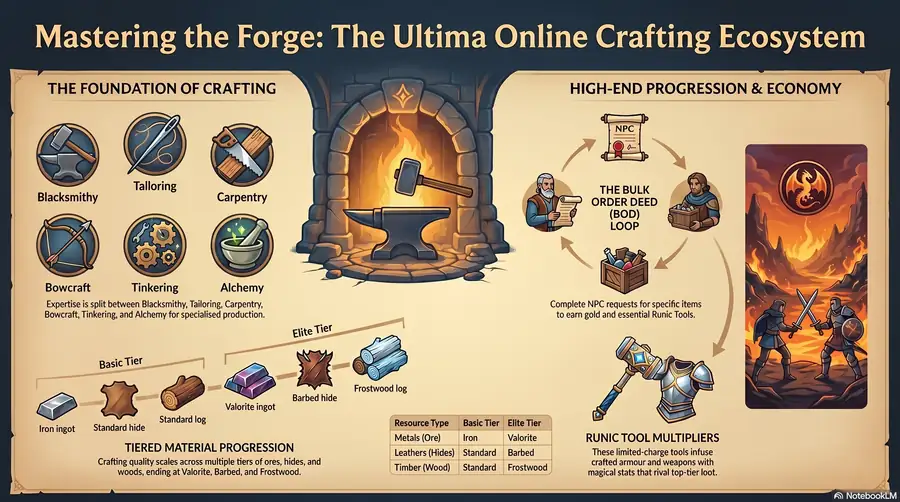
Crafting in Ultima Online is one of the deepest non-combat systems in any MMO. UO has six major crafting skills, a Bulk Order Deed (BOD) progression layer that runs for years, a real player economy with active markets, and crafted gear that — on most well-designed shards — competes with monster loot at the high end.
This guide covers how UO crafting actually works: which skills do what, how BODs work, what materials matter, and how the economy fits together. Specific shard tunings vary; the fundamentals below apply almost everywhere.
The Major Crafting Skills
Six skills carry most of UO crafting:
- Blacksmithy is the heaviest crafter — armor and weapons. Top-end smithing recipes use rare ores and runic hammers; the per-item value at the high end is the highest of any craft.
- Tailoring is the leather-and-cloth craft — leather armor, mage cloth, bandages-as-product, bow strings. Strong steady market.
- Carpentry makes furniture, shields, clubs, quarterstaffs, polearms, and wooden weapon parts (bow shafts that Bowcraft/Fletching uses to assemble bows). Smaller niche but lower competition.
- Bowcraft / Fletching makes bows, arrows, and crossbows. Often paired with Carpentry as a "ranged-weapon specialist" build because bow shafts use wood from the Carpentry side.
- Tinkering makes tools, locks, traps, jewelry settings. The "infrastructure" craft — every other crafter needs your tools.
- Alchemy makes potions, elixirs, and reagent-derived consumables. Pairs with Magery (you need reagents).
A few additional support skills bridge crafting and combat:
- Mining to gather ore for Blacksmithy and Tinkering.
- Lumberjacking to gather wood for Carpentry and Bowcraft.
- Cartography for treasure maps (a hybrid loop — find treasure, sell or use the contents).
Most crafters specialize in one craft + adjacent secondaries on a single character.
Bulk Order Deeds (BODs)
BODs are the canonical long-term crafter progression system. The mechanic:
- An NPC vendor periodically offers a BOD — a request for a quantity of items at a specific quality.
- Example BOD: "10 iron daggers, exceptional quality."
- You fill the BOD by crafting the items and depositing them in a designated NPC's inventory or via the BOD interface.
- Filling earns a reward: gold, a runic tool of varying tier, or a Large BOD (a higher-tier BOD that combines several Small BODs into one).
- Higher-tier BODs ask for harder items (specific materials, higher quality, exceptional + colored ore) and reward better runic tools.
The BOD progression is parallel to skill progression. A character can hit 100 Blacksmithy without ever filling a BOD. But the highest-end runic tools — and therefore the best crafted items — come from BODs. Engaged BOD crafters end up with significantly better gear-producing capability than non-BOD crafters at the same skill level.
Runic Tools
Runic tools are the multiplier on what crafted gear can do. They:
- Modify the item's stats with runic-specific properties (weapon damage modifiers, armor resist boosts, magical infusions).
- Have a limited number of charges.
- Drop rarely from monsters AND from BOD rewards. BOD-routed runic tools are the predictable supply; loot drops are bonus.
- Scale by tier — a low-tier runic adds modest properties; a top-tier runic produces top-end items.
Without runic tools, crafted items are good. With runic tools, crafted items are competitive with the best loot drops in the game. The BOD → runic loop is what makes crafting an actual high-end path rather than a leveling distraction.
Materials and Their Tiers
Each craft has a tiered material progression:
Smithing (ore tiers):
- Iron → Dull Copper → Shadow Iron → Copper → Bronze → Gold → Agapite → Verite → Valorite
Higher-tier ores produce items with native colored hue, better stats, and runic-tool requirements that scale with tier.
Tailoring (hide tiers):
- Standard Leather → Spined → Horned → Barbed
Same idea — higher tier = better stat ceiling on the crafted leather armor.
Carpentry / Bowcraft (wood tiers):
- Standard wood → Oak → Ash → Yew → Heartwood → Bloodwood → Frostwood (ML/post-ML expansions)
Most shards add their own top-tier materials above the standard list — Fel-Iron, Blood Crystals, Dragon Hide variants — that drop only in Felucca or restricted zones. These are what gate the top-end recipes.
Crafting Quality
Each crafted item has a quality flag:
- Standard (no marker) — basic stats.
- Exceptional — improved stats, gates entry to most BOD rewards.
- Mastercrafter / Grandmaster signed (varies by shard) — adds your character's name as the maker; some shards give signed items extra modifiers.
Most craft skills have an "Exceptional chance" that scales with skill and material tier. Hitting 90+ skill with the right material consistently produces Exceptional items.
Player Economy and Vendors
UO's economy runs on player vendors. Mechanics:
- A character with a house can place an NPC vendor inside.
- The vendor accepts items + prices from the owner; passersby buy the items.
- The owner pays a daily vendor fee; gold piles in the vendor's inventory until collected.
- Modern shards often add a web-based market browser so buyers can search vendor inventories without physically visiting houses.
A successful crafter:
- Stocks one or more vendors with mid-tier crafted gear in volume.
- Takes occasional high-end commission orders for runic gear.
- Trades raw materials with adjacent crafters or Fel-side farmers.
- Builds a reputation in the shard's
#tradechannels.
Solo crafters who never engage with the social layer can still make gold; they make less than crafters who plug into the trade scene.
Felucca-Exclusive Materials
Most shards put their top-tier crafting materials in Felucca:
- Higher mining yields and rare ore spawn rates.
- Exclusive monster drops (Dragon Scales, Blood Crystals, Fel-Iron variants).
- Champion-spawn drops that include crafting reagents.
Crafters who want top-end items either:
- Farm Fel personally — high margin, real PvP risk.
- Buy from Fel farmers — lower margin, much safer.
This design choice intentionally couples the crafting economy to the risk facet. It keeps Felucca relevant for non-PvPers and gives crafters a reason to know who the active Fel farmers are.
How Long Until a Crafter Pays Off
A rough timeline for a focused crafter:
- Week 1: 50–60 in primary craft skill. First sellable items. Small daily income.
- Weeks 2–3: 70–80 in craft + working secondary (Mining, Lumberjacking). Reliable mid-tier gear sales.
- Month 2: 100 in primary craft. First BODs filled. First runic tools earned.
- Month 3+: Consistent runic-tool supply. Top-tier item production. Reputation in trade channels.
A crafter is gold-positive earlier than a fighter is. Crafters tend to be the wealthiest characters on a healthy shard at the 3-month mark.
Common Mistakes
- Skill-grinding without BOD-engaging. Skipping BODs in the 70–100 stretch leaves you starting from zero on the BOD ladder at 100. Engage early.
- Hoarding runic tools. Runic tools have limited charges. Use them on the best BOD-tier items you can produce; don't save them for "later."
- Ignoring the secondary skills. A pure Blacksmith without Mining buys ore at 2x cost. The secondary skill is part of the crafter, not optional.
- Skipping Recall (Magery 50+). A crafter without Recall is glacial. The mobility cost compounds across thousands of trips between mine, smelter, vendor, and bank.
- Not pricing competitively. Vendor pricing isn't intuition — check the shard's market browser, see what sells, price slightly under top competition.
How Crafting Works Specifically on Immortal Realm
Immortal Realm preserves the standard UO crafting structure (six major skills, BOD progression, runic tools, tiered materials) and adds:
- A web-integrated auction house and market browser so crafters don't have to physically run their vendors.
- Fel-exclusive materials (Fel Iron, Blood Crystals, Draconic Scales) gating top-tier recipes.
- A
#tradeDiscord channel where the active crafters take commissions and post stock. - Real gold sinks (housing upkeep, vendor fees, repair costs) that keep the economy from inflating.
The shard-specific deep dive is in Crafting on Immortal Realm. The broader system map (where crafting fits in the overall design) is in Immortal Realm Custom Systems.
For more shard-shopping context, Best Ultima Online Shards compares shards including a "best for crafting and economy" lens. For build templates that are crafter-friendly, Ultima Online Builds covers the canonical crafter templates. The pillar Ultima Online Guide is the bigger picture if crafting is one of several things drawing you back to UO.
Slide deck
For an artisan-focused walkthrough of the UO crafter economy in slide format:
The Artisan Blueprint — full slide deck (PDF) · PowerPoint version