
This walkthrough assumes you've installed ClassicUO, made a profile, and connected to Immortal Realm — if you haven't, How to Play Ultima Online covers the setup. From here, you have a fresh login, a character creation screen, and questions.
This page answers them in the order they come up: profession choice, the New Haven start, the first hour, and what to do next.
Choose Your Profession
Character creation gives you a starting profession. This is not permanent — you can train any skill on any character, and your starting profession only sets initial skills and gear.
That said, the right starting choice makes the first hour much smoother. Recommended in order:
- Warrior — Swordsmanship, Tactics, Anatomy, Healing. Solid solo-survivability. Easiest learning curve. Can switch to a mage or hybrid later by training Magery on the side.
- Paladin — Swordsmanship + Chivalry. Slightly more complex than pure Warrior but the Chivalry spells (Close Wounds, Consecrate Weapon) are immediately useful. Beginner-friendly with a small ceiling boost.
- Mage — Magery, Eval Int, Meditation, Resisting Spells. Powerful at 70+ skill but punishing 1–50. Recommended only if you're patient or have UO experience.
- Blacksmith — Crafting profession. Fine choice for an experienced UO player; not a first-character recommendation because crafters need a fighter for materials.
If you're new to UO entirely, pick Warrior. The first-hour experience is materially smoother.
The New Haven Start
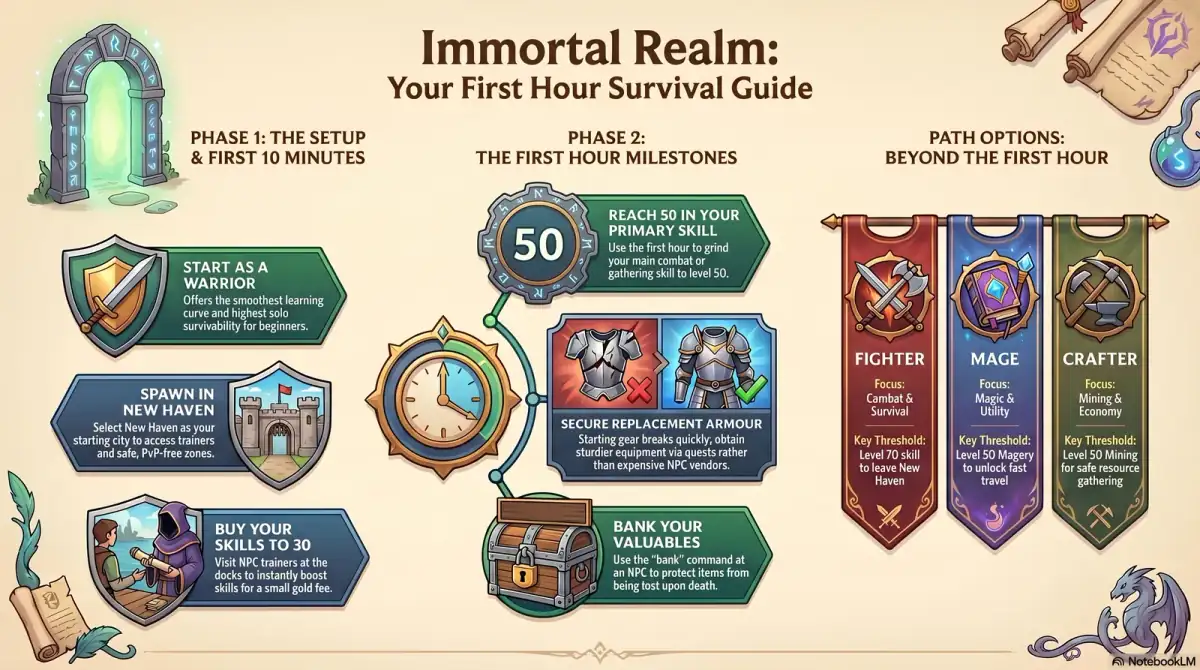
Pick (T) New Haven from the starting-city list at character creation. The shard uses stock UO character creation (no custom override in Scripts/custom/) — whichever city you pick at the city-list step is where you spawn. If you accidentally pick Britain or another city, you'll need to walk or moongate to New Haven to start the welcome quest.
New Haven is the curated tutorial city — it has skill trainers for almost every skill, NPCs that offer first-hour quests, vendors with cheap basic gear, and a calm population. PvP is impossible here (Trammel facet).
A dedicated walkthrough of New Haven specifically — the welcome quest, the six starter quests, and the Young protection layer — lives at Immortal Realm New Haven. This section gives you the broader path; that page goes deeper into the on-ramp itself.
For session-by-session planning, the Player Handbook collects the practical pages you'll keep open while playing: Your First Day, Your First Week, Commands Reference, Travel Guide, Currencies, and Death and Recovery.
Your first ten minutes:
- Open your bank. Speech command: type bank while standing at a banker NPC. Your bank box is your shared inventory across characters on the account. Verify it works.
- Find the Inn. New Haven's Inn is the rendezvous point for new-player quest content. Quest givers stand outside or on the Inn floor.
- Talk to the trainers near the New Haven docks. Most basic skills can be bought up to 30 from NPC trainers. This costs a small amount of gold and saves you the time of grinding from 0.
- Pick up the New Haven quests. They're short, they teach you the basic verbs (combat, gathering, talking to NPCs), and they pay in gold + Time tokens.
By the end of the first ten minutes you should have: a working bank, 30+ skill in your starting two skills, a sense of where the trainers and Inn are, and a couple of active quests in your journal.
Your First Hour
Goals to hit in your first hour:
- Primary skill to 50. Use it. Warriors fight rats, Mages cast at training dummies, Crafters mine ore. 0–50 is fast.
- Secondary skill to 30. Buy from a trainer or grind it casually while your primary advances.
- Find your first piece of replacement gear. New-player starting gear breaks fast. Buy a sturdier weapon and a basic armour set from a vendor or pick them up as quest rewards.
- Stash valuables in the bank. Death scatters your inventory; the bank survives.
- Read the in-game help. Click the Help button on your paperdoll (the standard UO Help interface) — UO doesn't use slash-prefix commands; the shard's bracket-prefix command set is documented at Commands Reference.
If you finish all five before the hour is up, you're ahead of schedule. If you don't, you're fine — most new players get through three of these in their first session.
After the First Hour
Three branches:
If you want to be a fighter
- Push your primary combat skill toward 70. This is the productive zone — gains are steady and you can take on harder content.
- Train Anatomy and Healing in parallel. Both are passive — you raise them by attacking and bandaging.
- At 60–70, leave New Haven. Britain, Vesper, and Trinsic are the standard mid-tier cities for monster spawns. The road from New Haven to Britain is itself a learning environment.
If you want to be a mage
- Train Magery to 50 by casting at training dummies in New Haven. Buy reagents from any mage NPC.
- Add Eval Int and Meditation as you cast. Both gain passively.
- At 50, you can cast Recall (with Magery scrolls) and start using runebooks for fast travel. This is the quality-of-life threshold.
If you want to be a crafter
- Mining is the gateway. Train it to 50 in New Haven; the iron deposits north of the city are public-safe.
- Blacksmithy and Tailoring both follow naturally. Sell what you don't keep to vendors; the gold is mid but consistent.
- Find a guild with a fighter or two. They'll keep you in materials; you'll keep them in gear.
Find a Guild
UO is a social game and the social scene is mostly run on Discord. The shard's official Discord is linked from the download page; guild Discords are linked from theirs.
Joining a guild within your first week makes the second week much easier. You'll have:
- People to ask "is this normal?" without feeling silly.
- Group content that's hard to do solo.
- A guild bank, in some cases shared housing, often pooled crafting resources.
- A reason to log in beyond solo grinding.
Don't overthink it. Pick the first guild whose Discord seems active and friendly. You can always change later.
Engage With the Custom Layer
Once you have your basic skills going, the shard's custom systems are worth exploring:
- The College of Chirurgeons is the maladies-and-treatment institution. Even if you don't join, you'll interact with it the first time you contract a malady. Read Immortal Realm Custom Systems for the broader system tour.
- Hand-authored quests are scattered through the world. They pay in Time tokens. The quest givers are usually NPCs with names rather than generic "Quest Giver" labels.
- Civic verbs. Some Orders have public verbs available to non-members — Examination, civic donations, attestation requests. Trying them is how you find out if you want to join.
You don't have to engage with the institutional layer to have fun on Immortal Realm. But it's the system that distinguishes the shard, and most players who stick around end up in one Order or another within their first month.
What Doesn't Work
A short list of pitfalls specific to Immortal Realm:
- Walking into Felucca at 30 skill. You will die. You will be looted. Powerscrolls past 100 require Felucca, but you don't need them in your first month.
- Buying everything from NPC vendors. NPC pricing is bad. Player crafters undercut NPCs by a wide margin.
- Skipping the New Haven quests. They're worth more in gold-per-minute than grinding monsters at the same skill level.
- Multi-clienting from day one. Allowed within limits; unhelpful when you're learning. One character at a time, until you know the world.
When to Ask for Help
Today. Now. Before you've grinded an hour into a wall.
The shard's Discord has a #new-players or equivalent channel. Asking "what's the best way to get to 50 Magery from where I am" is a normal question. Asking after you've already burned three hours on the wrong path is the same question with more pain attached.
Once you've had a few hours and the basics feel comfortable, the shard's broader systems open up. Immortal Realm Guide is the high-level pitch. Immortal Realm Custom Systems is the system-level tour. The download page gets you in if you haven't already.
Visual reference
Click to enlarge.
Slide deck
For a longer-form, slide-style walkthrough of the new-player on-ramp:
Immortal Realm Starter Dossier — full slide deck (PDF) · PowerPoint version