Ultima Online turned 28 years old in 2025. By any conventional measure, the game should have died years ago — its publisher has barely shipped content for it since the early 2010s, the official servers have a small population, and modern MMOs out-polish it on every surface metric.
It hasn't died. In 2026, UO is actively played, actively developed, and actively expanding its scope through community-run shards. This page covers why, where the population is, and whether UO is worth your time today.
The State of UO in 2026
A quick honest snapshot:
- The official servers (run by Broadsword under the Ultima Online brand) remain online with a small, devoted population. The official ruleset hasn't shipped a major expansion in years.
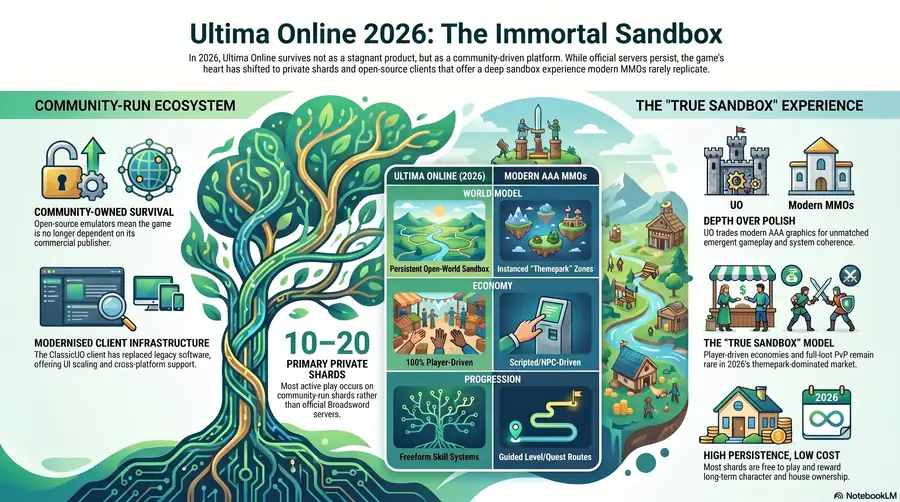
- Private shards — community-run servers using the open-source ServUO or RunUO emulators — are where most active UO play happens. Population is concentrated on roughly 10–20 well-run shards, with hundreds more existing as smaller experiments or hobby projects.
- Total active player count is hard to pin down (private shard operators don't always publish, and accounts cross shards). Reasonable estimate: a few thousand globally on the active shards combined, with concurrent prime-time populations of a few hundred on the largest individual shards.
- The client situation is healthier than it has ever been. ClassicUO (open-source, cross-platform, actively maintained) has effectively replaced the legacy Classic Client for serious play. Setup is faster, modern features (UI scaling, plugin support, Linux / Mac builds) are mature.
UO is smaller than it was at peak in the early 2000s. It is also more durable than it was — the open-source server tooling means the game is no longer dependent on its commercial publisher for survival.
Why Hasn't UO Died?
A few structural reasons:
The sandbox design has no modern peer
Modern MMOs almost universally pursue the WoW model: themepark zones, instanced content, story-driven progression, raid-and-dungeon endgame. UO's sandbox model — open world, player-driven economy, full-loot PvP, freeform skill systems, player housing as real space — is genuinely rare in 2026. The handful of attempts to recreate the formula (Mortal Online, Albion, others) capture pieces but not the whole.
For players who specifically want a sandbox MMO, UO remains a good option in part because almost nothing else fills the niche.
Community development outlives commercial development
ServUO and RunUO are open-source UO server emulators. Together they form a robust community-development ecosystem: shard operators ship their own custom systems, fork upstream code, contribute fixes back, run their own roadmaps. The official servers are no longer the only — or even the primary — venue for ongoing UO content.
This means UO has effectively become a "platform" rather than a "product." The sandbox base layer is preserved; what gets built on top of it is decided shard by shard.
Low cost of entry, high persistence
Most private shards are free. The Classic Client data files are free. ClassicUO is free and open-source. A returning UO player can start playing for the cost of an evening's setup.
That low entry cost + UO's tendency to produce long-running characters (skill cap, player housing, social relationships) means returning players bring real continuity. Many players who quit in 2005 and returned in 2025 still have characters in some form on some shard.
Where the Population Actually Is
The official servers remain online but are not the center of the active population. Active UO play in 2026 happens predominantly on private shards, with rough categories:
- Era-specific shards — explicitly target a specific historical UO ruleset (T2A, AOS-era, ML-era) with minimal divergence. Population is mostly returning players who specifically want that era.
- Custom-systems shards — run their own custom progression, items, balance, lore. The most common type of active shard in 2026. Examples include Outlands, UO Forever, and Immortal Realm.
- Hardcore PvP shards — focused on full-loot PvP with smaller PvE footprint. Smaller population but active.
- RP / story shards — emphasize roleplay, lore, GM-run events. Niche but durable.
- Hobby / experimental shards — small populations, often run by one or two operators trying out specific design ideas. The vast majority of shard names fall here; a small fraction of total player time.
Picking a shard is the meaningful choice in 2026. "Should I play UO?" is a less important question than "which shard should I play?" — they have wildly different feels.
Best Ultima Online Shards compares shards by category. For most returning players, that's the right next read.
Modern UO vs Modern MMOs
Honest comparisons:
- UO has lower production values than any modern AAA MMO. The 2D sprite art is dated. The UI is dated.
- UO has gameplay depth that essentially no modern MMO replicates. Player-driven economy, full-loot risk, skill-based character building, persistent open-world housing — these are not standard modern features.
- UO has lower polish but higher coherence. Modern MMOs frequently feel like collections of separately-designed systems; UO's systems plug into each other in ways that produce emergent play.
- UO has worse onboarding than any modern MMO. The first hour of a fresh modern MMO is glossier and friendlier than the first hour of stock UO. (Custom shards mitigate this with guided New Haven starts.)
If "polished and friendly to new players" is what you want, modern MMOs win. If "deep, durable, sandbox" is what you want, UO is the canonical answer.
Ultima Online vs Modern MMOs covers this comparison in more depth.
Should You Play UO in 2026?
A short list of reasons to play in 2026:
- You played UO years ago and have always meant to return.
- You want a sandbox MMO and the alternatives haven't satisfied you.
- You want a player-driven economy where crafting genuinely matters.
- You want full-loot PvP with the choice of when to engage.
- You're curious about what classical MMO design felt like before the WoW model standardized everything.
- You want a community small enough that individual players matter.
A short list of reasons not to play UO in 2026:
- You want modern AAA polish and presentation.
- You want guided story content and clear quest progression.
- You want a population large enough that you're never alone.
- You want voice integration, mobile companion apps, and modern UX conveniences.
- You don't want to pick a shard before you can pick a game.
There's no shame in either answer. UO is a specific kind of experience and isn't trying to be everything.
How Custom Shards Keep UO Alive
The single most important fact about UO in 2026 is that its survival is community-owned. The official servers are a backdrop; the active center of UO is the private shard scene.
That matters because:
- Active development is shard-specific. Each shard ships its own roadmap, its own custom systems, its own balance choices. A player can find a shard that matches what they want from UO with much higher specificity than picking a single canonical version.
- Failed experiments don't kill the game. A shard that doesn't work shuts down or pivots; UO itself continues. The platform is decoupled from any single instance of it.
- Innovation comes from below. Custom Orders, malady systems, story-driven quest lines, civic mechanics — these are the kinds of design ideas that wouldn't survive a commercial AAA development cycle. Custom shards are where this work gets done.
Immortal Realm Custom Systems is one example of what a custom shard does with the platform. Best Ultima Online Shards is a broader survey of the active shard scene.
How to Get Back In
If you're returning to UO, the practical path:
- Read How to Play Ultima Online — modern client setup is much easier than it used to be.
- Read Best Ultima Online Shards — pick the shard category that matches what you want.
- Try one shard for a week. If it doesn't fit, try another. The cost is mostly time.
- When you find one you like, plug into its Discord, find a guild, build a character, settle in.
The 2026 UO experience is genuinely good if you find the right shard. The wrong shard will feel like a dead game; the right one will feel like the most alive sandbox in the genre.
The pillar Ultima Online Guide is the broader overview if you want to step back and read the full landscape first.
Slide deck
For a longer-form, slide-style walkthrough of the 2026 UO landscape:
Ultima Online 2026 — Decentralized: full slide deck (PDF) · PowerPoint version