Modern MMOs are polished, story-driven, and friendly to new players. Ultima Online is none of those things. UO is also still played — and with considerable engagement — twenty-eight years after launch, while many of the polished modern MMOs that were going to "kill UO" are themselves dead or struggling.
This page is an honest comparison: where modern MMOs win, where UO wins, and which player each one is for.
What "Modern MMO" Means Here
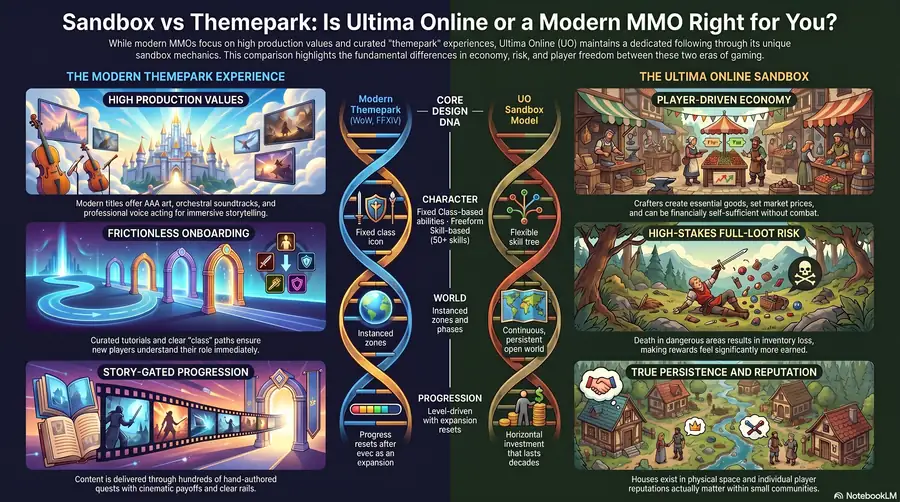
When this guide says "modern MMOs," the reference points are the post-WoW themepark model: World of Warcraft, Final Fantasy XIV, Guild Wars 2, the Elder Scrolls Online, New World, and broadly similar games. They share design DNA:
- Class-based characters with set abilities.
- Level-driven progression with story-gated content unlock.
- Themepark zone design — discrete content areas with curated quest paths.
- Instanced dungeons and raids for the bulk of cooperative endgame.
- Cosmetic monetization plus subscription or one-time purchase.
- Polished production values — full voice acting, AAA art, cinematic events.
UO predates all of this and was designed against different assumptions. The comparison below is between UO's design model and the modern themepark model — not against any specific game.
Where Modern MMOs Win
Honestly, plainly:
Onboarding
The first hour of a fresh modern MMO is incomparably better than the first hour of stock UO. Tutorial flows, voice-acted intro quests, automatic skill unlocks, clear visual design, in-game helpers. Modern MMOs invest heavily in the first hour because they know that's where players quit.
UO's first hour is a wall. Some custom shards mitigate this with guided new-player areas (Immortal Realm's curated New Haven start is one example), but the baseline is rough.
Production values
WoW, FFXIV, GW2 ship continent-scale art at a quality UO will never match. Music is original-orchestrated; cinematics are professionally rendered; voice acting is cast and recorded for major NPCs. UO is 2D sprite art on a 1997 engine. The visual comparison is not even close.
Content density
Modern MMOs ship hundreds of hand-authored quests with branching paths, narrative consequences, and cinematic payoffs. UO has narrative content (especially on custom shards), but the volume and polish gap is real.
Class clarity
A new WoW player can pick "Paladin" and get a coherent kit of abilities, a clear role in groups, and a known progression path. A new UO player has to assemble their own character from a 50-skill list with no guardrails. The class abstraction is friendlier.
Population
Modern MMOs have hundreds of thousands of concurrent players. UO has a few thousand globally, concentrated on shards. For "the world feels populated," modern MMOs win.
If these things matter most to you, modern MMOs are probably the better fit.
Where UO Wins
The other side, equally honestly:
Player-driven economy
UO has a real player-driven economy. Crafters make goods that compete with the best loot. Materials have scarcity. Vendors have prices set by players. A character can be financially self-sufficient and socially relevant without ever fighting a monster.
Modern MMOs have auction houses, but the economies are mostly cosmetic — gear comes from drops and quests, materials come from crafting nodes that anyone can hit, and inflation is structural. The "crafter as a real character class" doesn't exist in most modern MMOs.
Full-loot risk
In UO, what you carry into Felucca is what you risk. Death drops your inventory. The risk is real, and so the rewards feel earned.
Modern MMOs almost universally avoid full-loot. Death is a hand-slap (rez at a graveyard, durability hit, run back to your corpse). The stakes are deliberately low because high stakes drive players away.
For players who specifically want stakes, UO is one of very few options.
Sandbox freedom
UO has no class. You build the character you want. You pick the skills, you set the goals, you decide what success means.
Modern MMOs have classes and progression rails. You play the class as designed; you progress through the content as authored.
Both are valid; they're not the same. UO sandbox players genuinely prefer building their own character. Themepark players genuinely prefer the curation. The answer depends on which kind of player you are.
Persistent open world
UO is one continuous open world (per facet). Houses are placed in real space; players can build adjacent. Towns have real geography; player vendors are physical buildings. Travel matters.
Modern MMOs are largely instanced or phased. Your "world" is a sequence of zones, with major content in instanced dungeons. The sense of "this is one continuous place" is much weaker.
Player-mattering
In UO, individual players matter. The shard population is small enough that named characters get recognized; reputations are real; the big crafter / the famous PvPer / the well-known guild leader are people other players actually know about.
Modern MMOs at scale make individual players largely interchangeable. Your guild matters; you specifically usually don't.
For players who want a community where they can be a recognized member, UO is a better answer.
Longevity of investment
A UO character built in 2010 can still be played in 2026 (assuming the shard still exists). The skills you trained, the house you built, the gear you crafted — all still relevant. Modern MMOs reset progression every expansion; the gear you grinded for last year is replaced by basic quest gear in the new expansion.
UO's "investment lasts" pattern is rare and durable.
Which Player Is Each For?
A short framework:
You probably want a modern MMO if:
- You want polished, story-driven content.
- You want a class-based character with clear roles.
- You want clear progression rails and unambiguous endgame.
- You want a population large enough that the world always feels alive.
- You want low-stakes, low-friction gameplay.
- You're new to MMOs and haven't already developed strong preferences.
You probably want UO if:
- You want a player-driven economy where crafting matters.
- You want freeform character building without classes.
- You want full-loot stakes (or the choice of when to engage with them).
- You want a small-population community where individual players are visible.
- You want a sandbox open world with player housing as real space.
- You played UO before and have always meant to return.
- You've tried multiple modern MMOs and felt like something was missing.
You probably want both if:
- You play multiple MMOs anyway.
- You want different things at different times.
- You have a stable game group in modern MMOs but want a sandbox solo loop.
There's no rule against playing both; many active UO players also play one or two modern MMOs concurrently.
How Modern UO Modernizes the Formula
The "UO design but modernized" question is a real one — and it's mostly answered by custom shards.
A modernized UO experience in 2026 typically includes:
- A guided new-player path. Curated New Haven start, tutorial quests, recommended profession defaults.
- Quality-of-life UI. Modern UO clients (ClassicUO) ship features the original 1997 client never had — proper UI scaling, plugin support, paperdoll improvements.
- Active development. Custom shards ship regular patches, balance updates, and new content — meaningfully more activity than the official servers receive.
- Web-integrated infrastructure. Modern shards ship web-side market browsers, auction houses, leaderboards, account portals.
- Coherent design rather than feature creep. Well-run custom shards make deliberate design choices and stick to them; the result is more coherent than 25 years of accreted EA-era expansions.
Immortal Realm Custom Systems is one example of how a 2026 custom shard handles the modernization question. Immortal Realm Progression covers the specific progression tunings that try to keep the UO sandbox feel while smoothing the rough edges.
When You're Ready to Try
If you want to try UO after years of modern MMO play:
- Read Ultima Online in 2026 for the population picture.
- Read Best Ultima Online Shards and pick a shard category.
- Read How to Play Ultima Online for setup.
- Pick one shard; play for a week.
Don't try to recreate your modern MMO experience in UO — they aren't the same game. Try to learn what UO is on its own terms. The first week is the steepest; players who get past it tend to stay.
The pillar Ultima Online Guide is the bigger picture if you want a full overview. The download page is the on-ramp if you want to skip ahead and just try it.
Slide deck
For a design-comparison walkthrough in slide format:
The UO Design Diagnostic — full slide deck (PDF) · PowerPoint version